
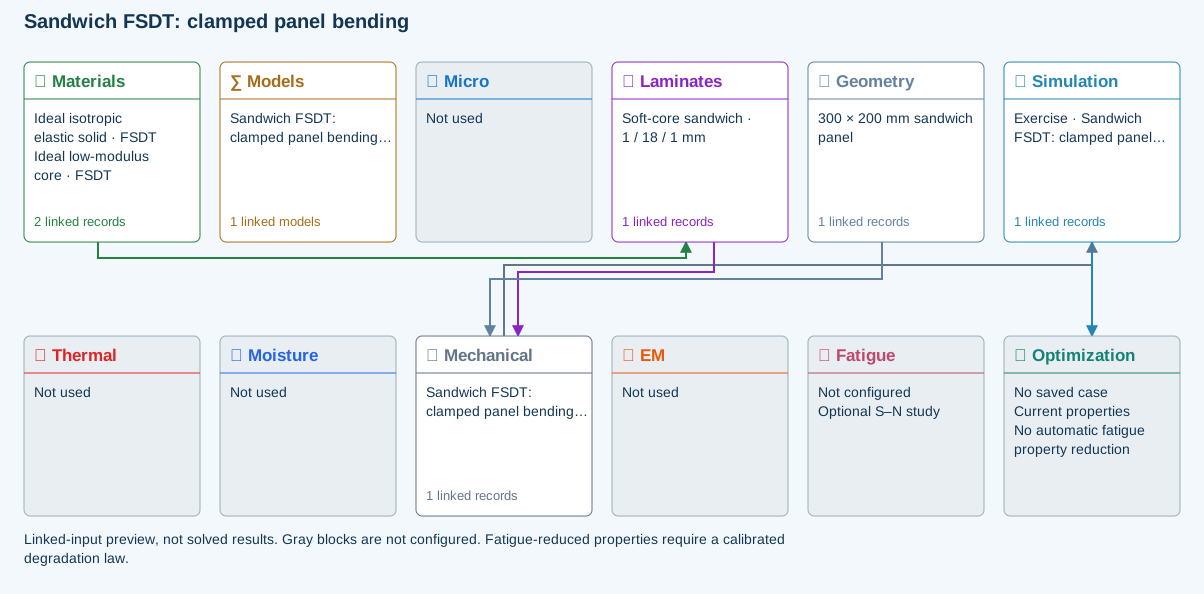
Linked-input preview, not solved results. Gray blocks are not configured.
∑ Selected models & submodels
These are the exercise’s linked choices, not solved results. Open a first-layer model to see its submodels and scope.
Automatic · Finite plate · Sandwich FSDT: clamped panel bending · load
Automatic selects FSDT for sandwich architecture and CLT otherwise. Static bending requires FSDT. Finite-plate studies do not consume process links or run progressive failure/fatigue.
Study · Static bending
Reference-elastic plate study; progressive failure and fatigue are not evaluated here.
Numerical settings
Ritz order: 6. Shear correction (FSDT only): Energy equivalent. Increase resolution to check convergence.
Data travelling between blocks
Materials → Laminates
Stored ply stiffness, strength, density and expansion properties.
Mechanical → Simulation
SIMULATION selects this case and its analysis model; the case owns its applicable cycle and input references.
Laminates → Mechanical
Ply angles and thicknesses, stiffness, mass and ply properties.
Geometry → Mechanical
Shape and dimensions for the selected structural analysis.
Simulation → Optimization
Linked inputs and current-property response for candidate evaluation.
Where FSDT fits
Classical laminate theory supplies membrane, extension–bending and bending stiffness: A, B and D. First-order shear deformation theory (FSDT, or Reissner–Mindlin plate theory) retains those matrices and adds transverse shear flexibility. It does not generate a second set of constituent properties or replace the Micro model.
Sandwich plate default: new finite-plate analyses use Automatic theory. When the linked laminate Architecture is Sandwich Structures, Automatic resolves to FSDT; other architectures resolve to CLT. The choice is reevaluated when the linked laminate changes. Explicit CLT and FSDT selections are retained for comparisons. Use the default Energy equivalent shear correction for compatible sandwich plates. Missing shear properties or unsupported symmetry/geometry stop the run, rather than silently substituting CLT.
The three-point-bend sandwich beam example retains its separate shear-flexible beam and skin/core/bond screening model. Its concentrated load and failure checks are not replaced by the current uniform-pressure FSDT plate solver. FSDT completion does not establish a sandwich failure pass.
| Stage | Inputs and responsibility |
|---|---|
| Materials / Micro | Each ply supplies E1, E2, ν12, G12, G13, G23 and density. Stored materials and solved Micro plies can share the laminate. |
| Laminate | Angles and unequal ply thicknesses generate the common A/B/D matrices, transverse shear matrix As and thickness-integrated mass. |
| Geometry | Finite rectangular plate length and width. Thickness remains owned by the laminate. |
| CASES / SIMULATE | Select CLT or FSDT, study, edge restraints, pressure or reference membrane loads. One Run executes the chosen formulation. |
Kinematics and stiffness
u(x,y,z) = u0(x,y) + z θx(x,y)
v(x,y,z) = v0(x,y) + z θy(x,y)
w(x,y,z) = w0(x,y)
γxz = θx + ∂w/∂x     γyz = θy + ∂w/∂y
[N; M] = [A B; B D] [ε0; κ]
[Qx; Qy] = As [γxz; γyz]
Rotations are independent of the displacement slope. The thin-plate limit drives transverse shear strain toward zero. The current CDS plate release solves w, θx and θy for symmetric reference-elastic laminates; it rejects non-negligible B coupling rather than discard in-plane/bending coupling. A/B/D are calculated by the same laminate implementation used by CLT.
Transverse shear properties
FSDT requires positive G13 and G23 for every ply. An isotropic stored material may derive them from its isotropic shear modulus; orthotropic records need directional data. Missing values cannot be replaced silently by G12.
- Energy equivalent: the default directional pure-bending approximation integrates equilibrium shear profiles through all plies, matches their shear strain energy and inverts the resulting 2×2 flexibility. It requires symmetric, specially orthotropic bending stiffness (D16 and D26 negligible). It recovers 5/6 Gh for a homogeneous section while accounting for a soft core.
- Uniform 5/6: explicitly applies 5/6 to the integrated rotated shear stiffness. This is a homogeneous-reference approximation, not a universal correction for sandwich or strongly heterogeneous laminates.
Directional energy approximation:
qi(z) = −∫(bottom→z) Q̄ii(s) s ds / Dii
Cs,ij = Σlayers ∫ qi(z) [Ḡs(z)⁻¹]ij qj(z) dz
As = Cs⁻¹

Uniform approximation:
As = (5/6) Σlayers Ḡs,k tk
The directional approximation is not a complete 3D stress recovery or a universal anisotropic warping solution. Its limits remain visible in results. As is reported in N/mm; Qx and Qy are integrated shear force per unit width, not interface stress.
Studies and boundary conditions
- Static bending: FSDT with uniform Plate pressure in MPa (= N/mm²). Clear Nx, Ny and Nxy. Outputs include physical w in mm, rotations in radians, Qx/Qy in N/mm, cursor sections, sampled peak |w| and the shear share of elastic energy.
- Modal: unprestressed, undamped frequencies. Through-thickness density integration includes rotary inertia I2 = ∫ρz² dz. Explicit positive density and symmetric mass distribution are required.
- Buckling: elastic bifurcation under uniform proportional Nx, Ny and Nxy. Negative normal resultants mean compression. The multiplier scales that load vector; it is not a strength or postbuckling limit.
| Edge | FSDT restraint |
|---|---|
| Simply supported | w = 0 and tangential rotation = 0; normal bending moment is natural. This is the hard simply supported convention. |
| Clamped | w = θx = θy = 0. |
| Free | Natural moment and transverse shear conditions; no essential displacement restraint. |
Numerical method and applicability
CDS uses a polynomial Rayleigh–Ritz formulation with independent displacement/rotation fields, enriched rotation spaces and exact-enough Gaussian integration for the polynomial products. Ritz order 4–8 controls spatial approximation. Refinement is essential, particularly for clamped edges, thin plates, soft cores and higher modes. A small algebraic residual does not establish spatial convergence.
The FSDT release accepts thickness / shorter side up to 0.2 as an implementation guard, not a universal accuracy guarantee. It excludes holes, thickness stretch, geometric nonlinearity, process residual preload, damping, contact, unsymmetric extension–bending coupling and mass coupling. Buckling and modal runs do not consume transverse-pressure preload. Extremely thin plates may be better conditioned with CLT.
No false failure pass. FSDT improves global response but does not establish interface peel stress, bond strength, delamination growth, core crushing or ply failure. Those require separately supported constitutive and interface models. The current FSDT release cannot be combined silently with the layerwise progressive-damage or delamination solver.
Try the dedicated exercises
These six examples are part of the shared default database and the searchable curriculum. They use idealized teaching properties, not qualified material allowables.
- Thick isotropic plate — static bending and thickness sensitivity ↗
- Cross-ply plate — CLT/FSDT buckling and frequency comparison ↗
- Soft-core plate — transverse shear and correction sensitivity ↗
- Sandwich panel — clamped uniform-pressure bending ↗
- Sandwich panel — biaxial compression buckling ↗
- Sandwich panel — directional-core natural frequencies ↗
Find these examples by searching FSDT or selecting the FSDT model →
Sandwich exercise sequence
Find these four studies under 07 · Sandwich FSDT in the default database simulation tree, or filter the exercise manual by FSDT and sandwich application. All use symmetric 1 / 18 / 1 mm skin–core–skin stacks, explicit shear properties and Automatic → FSDT. The unchanged teaching materials are shared; duplicate a record before making an independent variant.
| Exercise | Baseline setup | What to inspect |
|---|---|---|
| fsdt-03 · Shear-dominated bending | 200 × 200 mm; simply supported; 0.001 MPa uniform pressure | Physical deflection and shear-energy fraction; compare shear corrections. |
| fsdt-04 · Clamped panel bending | 300 × 200 mm; all edges clamped; 0.001 MPa uniform pressure | w, rotations and Qx/Qy cursor sections; compare simply supported edges and pressure scaling. |
| fsdt-05 · Biaxial buckling | 300 × 200 mm; simply supported; Nx = −1000 N/m, Ny = −500 N/m; pressure zero | First positive multiplier and proportional critical load pair; compare uniaxial compression and CLT. |
| fsdt-06 · Directional-core modes | 300 × 200 mm; simply supported; all applied loads zero; core G13 = 0.025 GPa, G23 = 0.0125 GPa | First three frequencies and normalized mode shapes, including rotary inertia; exchange core shear directions. |
For every study, refine Ritz order from 6 to 8 and record convergence before interpreting trends. These are idealized elastic teaching problems, not strength allowables or experimentally validated sandwich designs. Biaxial buckling is not a wrinkling, bond or core failure criterion; natural-frequency mode amplitudes are not physical vibration displacements.
Verification and validation
Automated module checks compare homogeneous shear stiffness with 5/6 Gh, simply supported static displacement with an independent double Fourier series, buckling with the shear-flexible Navier solution, and frequency with a rotary-inertia eigenvalue reference. Tests also check convergence toward CLT, clamped-edge refinement, required-property errors and the production data contract. These are analytical software verification, not experimental validation or validation of every exercise variation. Dedicated example results are not automatically given a full-model benchmark badge.
Primary references
- FEniCS-Shells: laminate ABD and Reissner–Mindlin shear stiffness — the separation between common laminate stiffness and transverse shear stiffness.
- FEniCS-Shells: clamped Reissner–Mindlin plate — independent rotations, shear energy and the need to control shear locking. CDS uses Ritz approximation, not this finite-element implementation.
- Abaqus theory: transverse shear stiffness in composite shells — energy-equivalent shear concepts and layered-section limitations. CDS's directional approximation is not identical to Abaqus's formulation.
Workbench availability: released models, inputs and compatible study paths. The wider theory library includes reference formulations not available in every Workbench solve.