
04.2 / CDS User Guide
Navigate the
Workbench workspace.
Understand the latest Project Manager, project tree, filters, record editor, and live connection summary.
Complete manuals · download a whole collection
Each collection includes an editable Word manual and its matching searchable PDF, with linked contents, explanatory text, diagrams and references. Theory equations use native Word mathematics. Individual-page PDF buttons remain available.
These are dated reading editions of the public learning content. Interactive studies and account-controlled classroom notes and databases stay online. For current changes, follow the chapter links back to the website.
Current Workbench, reference editions and downloads
Use the online User Guide for current controls, the released model directory for selectable models and compatibility, and the Training Manual for connected exercises. Wider theory references do not mean every formulation is enabled in Workbench.
Dated GUI captures and compiled Web r18 PDF manuals retain their stated scope; they are not a substitute for current hosted Workbench instructions. Find the overview PDF, guides and exercise databases in Your CDS library.
Explore the connected input path below. The dated GUI captures in the instructions show record controls; the current Simulation tab combines the earlier Solve and Summary views.
Stored ply properties bypass Micro. Mixed stacks keep both paths. Gray blocks are not selected. Geometry, process schedules and other model records are omitted here for clarity; a real run must include all required references.
Fatigue uses intact CLT endpoint stresses and measured S–N calibration. It is evaluated separately from Run and progressive failure. The dashed handoff is not active: optimization still uses current properties until a degradation law is supplied.
Materials → Micro → Laminate.
All exercises, case studies and simulation examples → · Your CDS library: overview, manuals and database downloads →
Inspect the selected model in Live Sim
SIMULATE opens with Live Sim, an input-driven view of the selected cases. The four selectors remain available above the scene. Switch to Blocks to manage candidate records and trace their connections.
- Select Geometry, Laminate, a constituent or a case to inspect the inputs that are actually used. Clicking a used block heading also opens its Live Sim inspection.
- Select a ply in the stack or geometry view to inspect its source. Micro-derived and stored-property plies are identified separately. Woven sources show the fabric unit-cell preview when applicable.
- Select the Thermal or Moisture case to inspect its surface boundary schedule. Move the step slider to compare prescribed conditions. This is not a solved internal temperature or moisture field.
- Use Edit input to open the source record. The scene follows the changed inputs; rerun the simulation before trusting previous results.
Use the current CASES database format
This release reads and saves the current CASES database format only. Thermal and Moisture schedules are stored directly with their cases. There is no separate Process record or old-format migration on opening a file.
- Download a current starter or exercise database from the library. Older-format files are rejected with a clear message rather than converted silently.
- Save and reopen the current database to retain case selections, schedules, candidate records and editable names.
- Missing folders, duplicate identifiers and cycles attached to absent cases prevent saving or opening. Blank physical inputs remain editable and must be completed before Run.
Choose the run in the SIMULATION block
SIMULATION is the control point for the run. Select a Thermal case, Moisture case, Mechanical case and EM case, or None in any slot. Each selected case shows its analysis model, laminate and applicable geometry.
- Keep candidate records in the surrounding blocks. Adding a candidate does not select it for execution.
- Select the required cases in SIMULATION and review their inputs before Run. At least one case is required.
- Use the same laminate for a supported combined run. Run standalone studies separately with the other selectors set to None.
- Run executes the selected combination. A connection or Used marker is not evidence of a successful solve.
Review every downstream geometry dependency
A geometry record can be shared by several cases and simulations. Editing its dimensions or type affects all linked consumers, including studies that are not currently open. Unrelated records are unchanged.
- After editing geometry, open Solver messages and expand Review affected cases and simulations. Select a linked name to inspect that record.
- Check the selected model, load basis, dimensions and boundary conditions. Loads are not automatically replaced when the geometry changes.
- Resolve incompatible geometry and model combinations before running. An I-section does not turn a plate theory into a beam theory.
- Rerun affected simulations before relying on previous results. Inputs changed warnings indicate that stored results no longer match their connected inputs.
Build the simulation from interactive blocks
Choose Block view above the left navigator for a vertical, editable workflow, or Blocks inside SIMULATE for the larger connection view. Live Sim inspects the selected model. Record dropdowns remain visible in Lite view.
- Choose the active simulation, then select compatible materials, Micro recipes, laminates, geometry and cases inside its blocks. Hybrid laminates can retain both stored-material and solved-Micro ply sources.
- Use the local Blocks Lite–Advanced switch for extra details without changing the rest of the workspace. Existing search and current-simulation filters still apply.
- Use the side connections to trace the input path. Hide connections or pause their animation locally; reduced-motion preferences are respected. Animation indicates connection direction, not solver progress.
Read the blue Used marker
Connected, available record selections have a soft blue glow and a Used marker in the corner. Hover or focus the marker to see which downstream record and field uses that input.
- Check the marker before editing a shared input: more than one case can consume it.
- A Used marker means connected, not solved or validated. Review solver status and outdated-result warnings separately.
- Missing or incompatible selections need repair; do not interpret an empty result as zero response.
Add, replace or disconnect a block input
The + control adds another available record to a block, excluding records already present. Use that record row dropdown to change the candidate, its link to open it, and − to remove it from the block. Library records are not deleted.
- Choose + and search for a compatible candidate not already in the block. Decide what actually runs with the four selectors in SIMULATION.
- If no compatible record exists, create one in Inputs. Each case owns its analysis model and applicable cycle. There is no separate Process block to connect.
- A used input must first be disconnected or changed at its consuming field. Review downstream warnings before confirming a removal; cancel to keep it.
- After removal, required missing inputs remain flagged and their selectors allow reconnection. Optional cases may stay disconnected. Rerun affected analyses before relying on their results.
Keep starter laminates in one classification
Generated Standard starter Conventional Laminates folders are consolidated into the main Conventional Laminates folder. Distinct laminate record IDs and their simulation links are preserved; identical titles alone are not a reason to delete a record.
Project Manager
The Project Manager at the upper left combines navigation actions with the selected record’s context menu. Use it for create, open, save, load, export, and settings actions.
- Select a tree item first.
- Open Project Manager.
- Confirm the action scope: selected record, subtree, or entire database.
- Choose the required action.
Compact project tree
The left tree follows the engineering data chain: Materials, Micromechanics, Laminates, Geometry, CASES and Simulations. CASES contains Thermal, Moisture, Mechanical and EM records, each with its own applicable cycle. A single click selects a row; its chevron expands or closes its children.
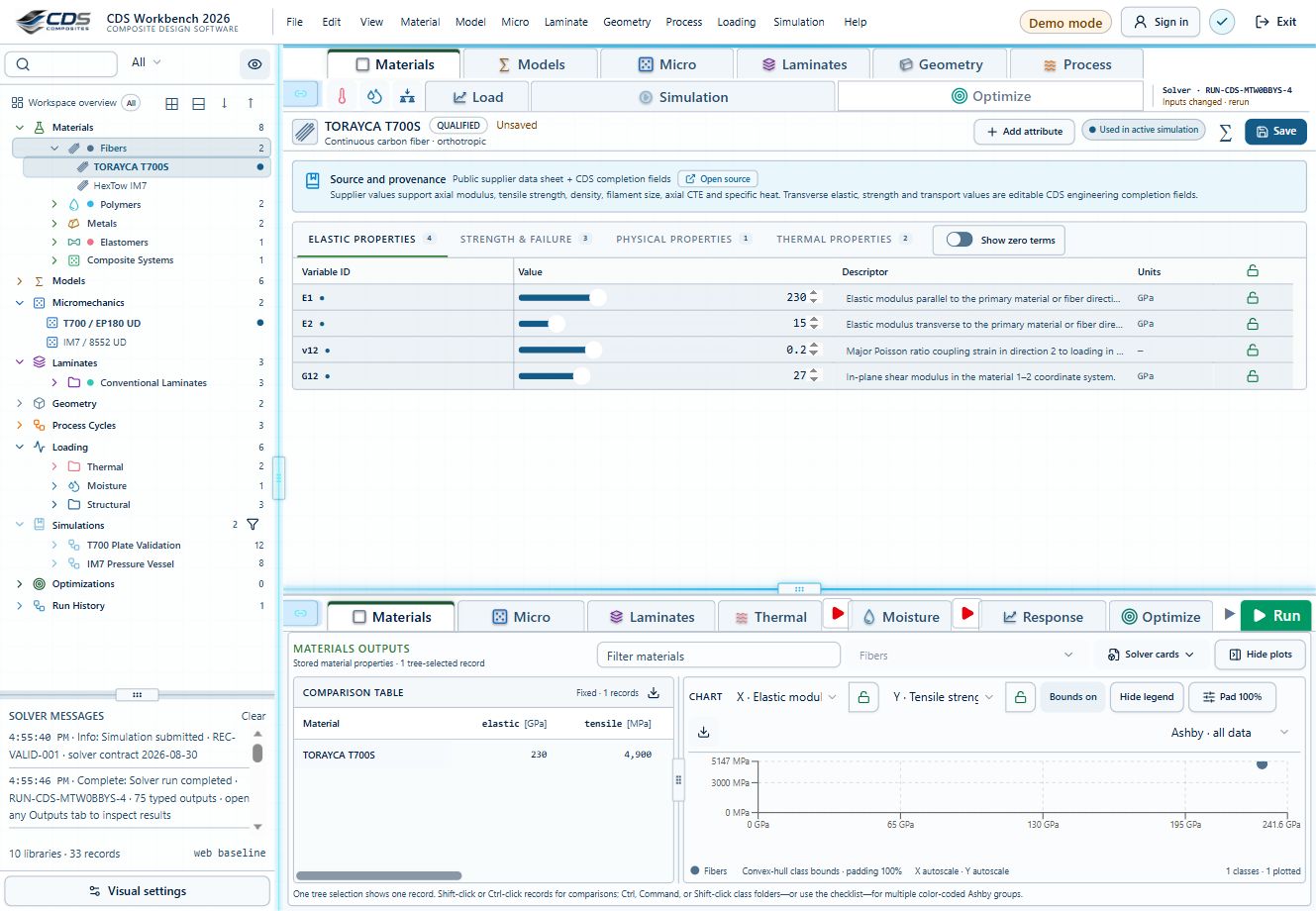
Search, filter, and visibility
Search locates records by title or descriptor. The All records dropdown and type filters narrow the visible records while preserving the primary tree. The eye control switches between the current simulation's records and all allowed records. Current simulation includes available candidates you added, even when they are not yet Used by the selected run.
- Enter a search term or choose a type filter. See screenshot
- Look for the blue active-filter treatment.
- Review Workspace filtered result.
- Clear search and filter to restore the full tree. See screenshot
Expand or contract the tree
Workspace overview and its tree controls remain above the scrolling records. The open-book icon expands all; the closed-book icon collapses all. The arrows expand or contract one level.
Selected record editor
Selecting an item opens its property editor. Compact tables show property names, descriptions, values, units and lock state. Predicted micromechanics and laminate properties remain read-only indicators; edit their connected source inputs instead.
Simulation workflow and scene controls
The Simulation tab combines the connected inputs and model workflow. Use Titles, Details, Table and zoom to fit it; Show data and Show model workflow reveal separate layers. The first click focuses a block and the next opens its record.
- Use the searchable simulation selector above the left tree to change the active case.
- Use the global Lite–Advanced switch for the workspace, or a local switch for one area.
- Inputs, Split and Outputs allocate pane space. Back and Forward revisit scenes, not previous data values.
- Use the visible Solver status to distinguish live updates, Run required and outdated results.
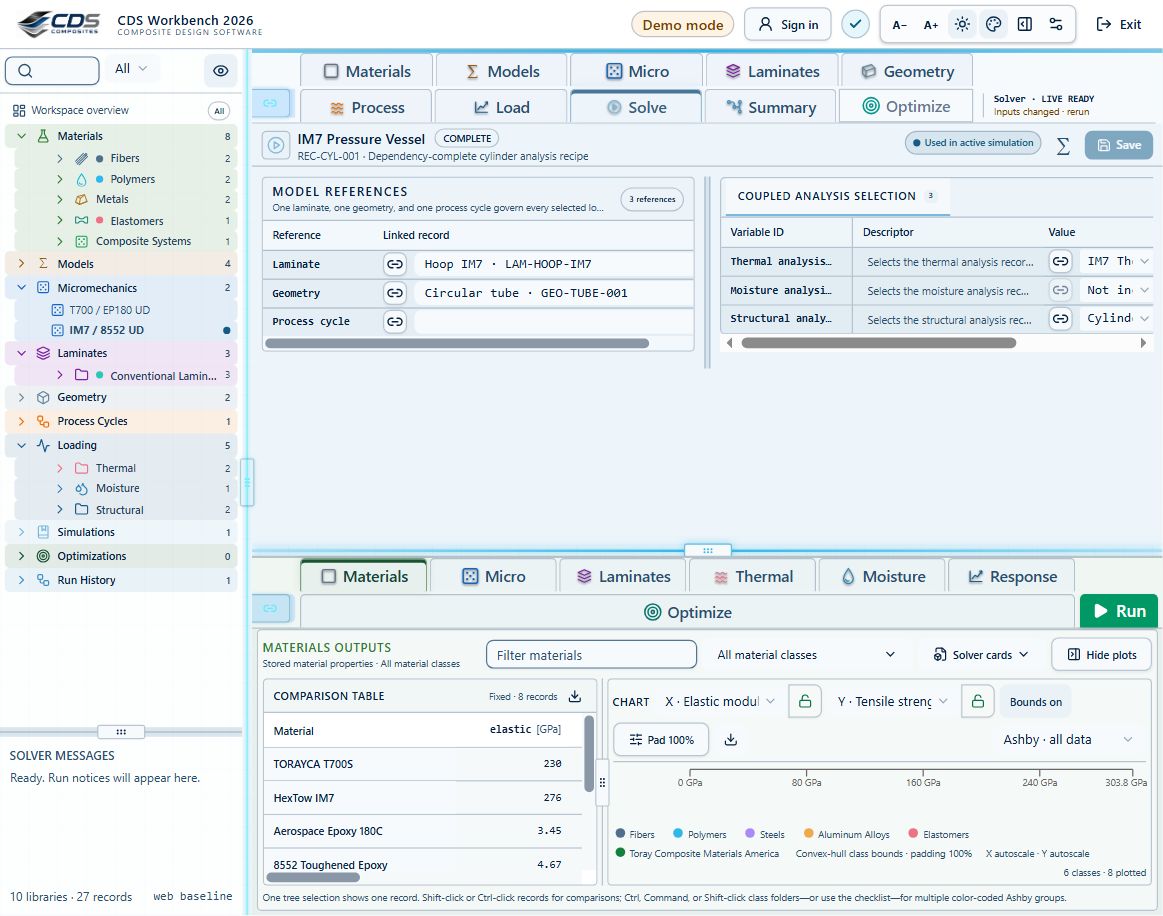
Results workspace
Materials, Micromechanics, and Laminates use the same four result views: Table, Ashby, Bar, and Line. The active tab is clearly highlighted. A single selected record shows its property view; multiple selected records use properties as rows and records as columns.
Workbench availability: released models, inputs and compatible study paths. The wider theory library includes reference formulations not available in every Workbench solve.