AI Supported

Real Time Composite Design

CDS unifies traceable material data, multiscale analysis, laminate and failure design, process simulation, optimization, and reusable engineering evidence in one environment.

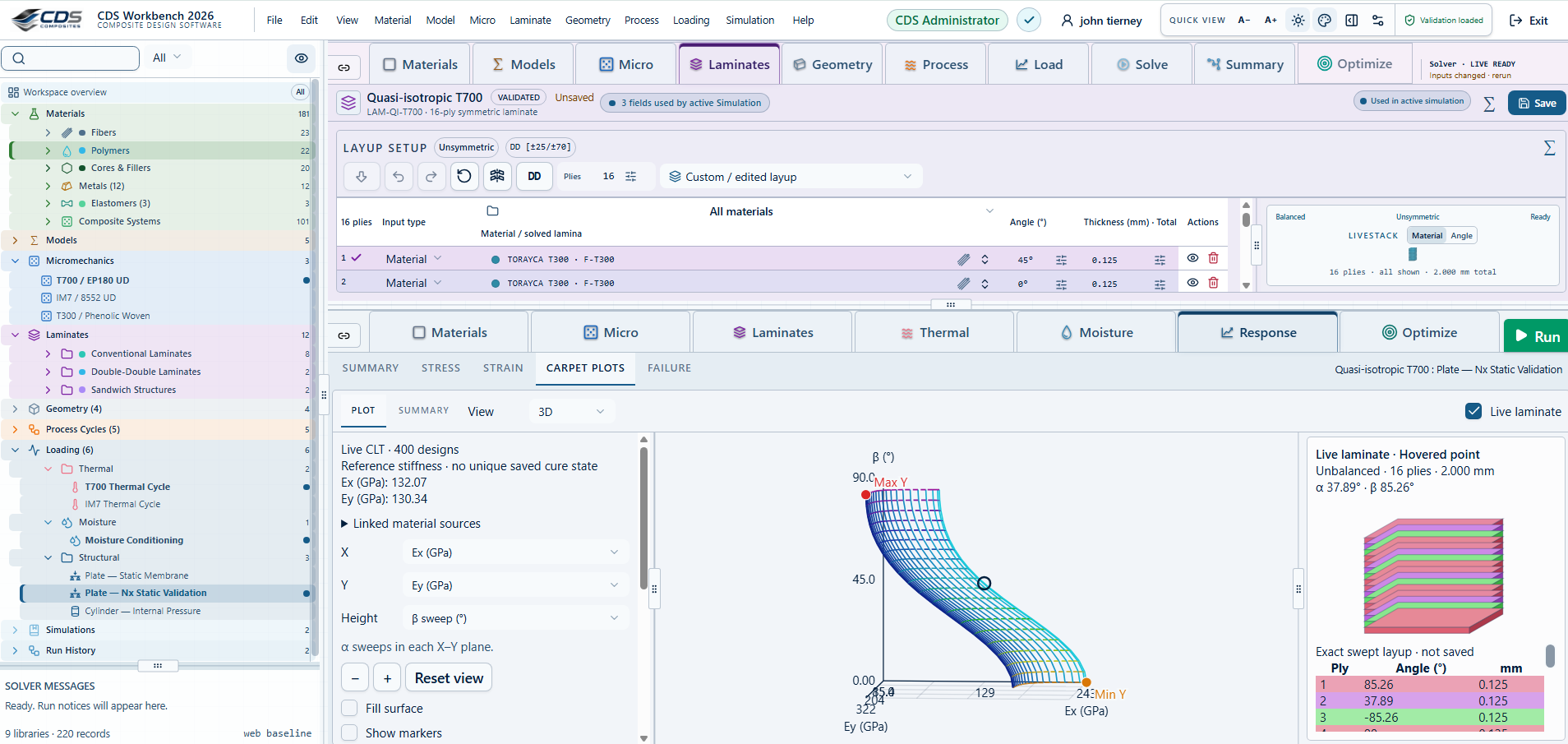
CDS Workbench laminate optimization view with the project navigator, layup editor, carpet plot, and live laminate

CREATE / Design recommendations

What would you like to make?

Choose a simple part. Start from a connected CDS exercise, then change one thing and see what happens.

1. Choose a part and load
2. Include a process study?

Start with an already-cured laminate and its mechanical response.

Teaching recommendations, not an optimized or validated part. Review material data, loads and model limits in Workbench before running.

Recommended starting point · 30 min

Laminate orientation and tensile response

Start with a flat coupon so you can see how fiber direction changes the response to a tensile force.
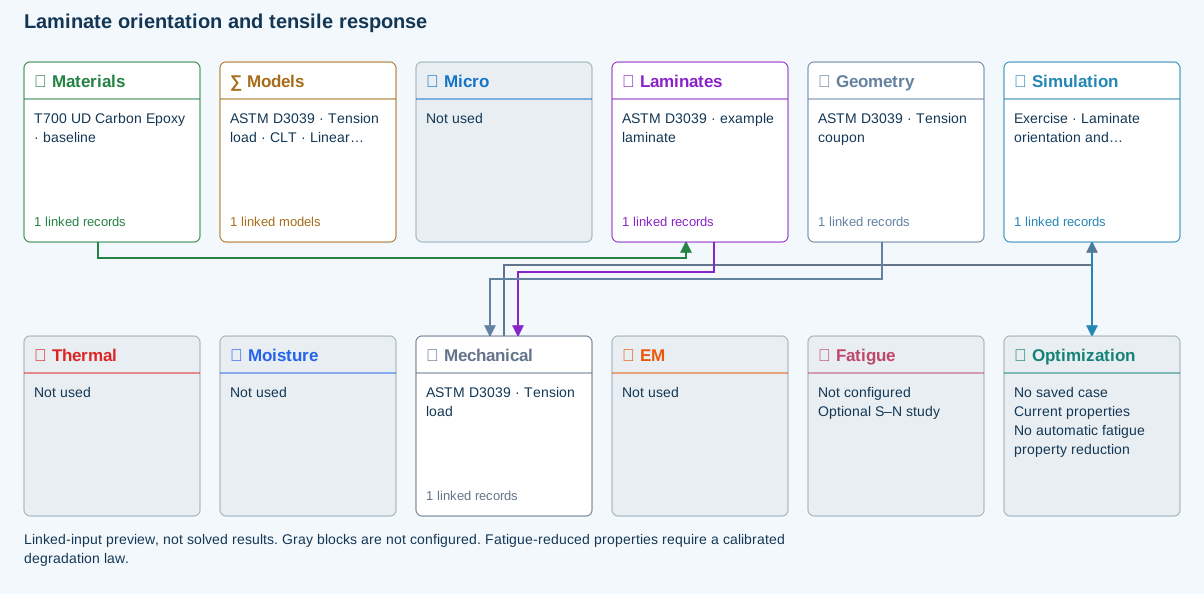
Laminate orientation and tensile response connected two-row simulation workflow
Connected input preview · two-row workflow. Gray blocks are not configured; this is not a solved result.

Your first design experiment

Compare symmetric cross-ply and balanced ±45° layups at the same thickness. Then add layers and compare the stiffness and mass.

Models, checkpoints and limits

Models: Classical laminate theory · Linear static · ASTM D3039-based

  • Geometry supplies the finite coupon width; the load is a total force.
  • A symmetric layup should have negligible extension–bending coupling.

ASTM-based teaching geometry, not certification. Grips, tabs, alignment and physical test validity are not simulated.

Read the model background →

Links open the shared exercise in Workbench. These website choices recommend a study; they do not modify or save a database. Editing and running remain subject to your Workbench access.
↑ Back to Create · Discover · Simulate

The workflow

From Micro to Macro all in one environment

Move between scales while preserving inputs, assumptions, methods, and results.

01 / Materials

Define constituent properties with traceable material data.

Build and compare fiber, matrix, filler, adhesive, core, vendor, and composite-system records while keeping units, source links, provenance, and editable assumptions visible.

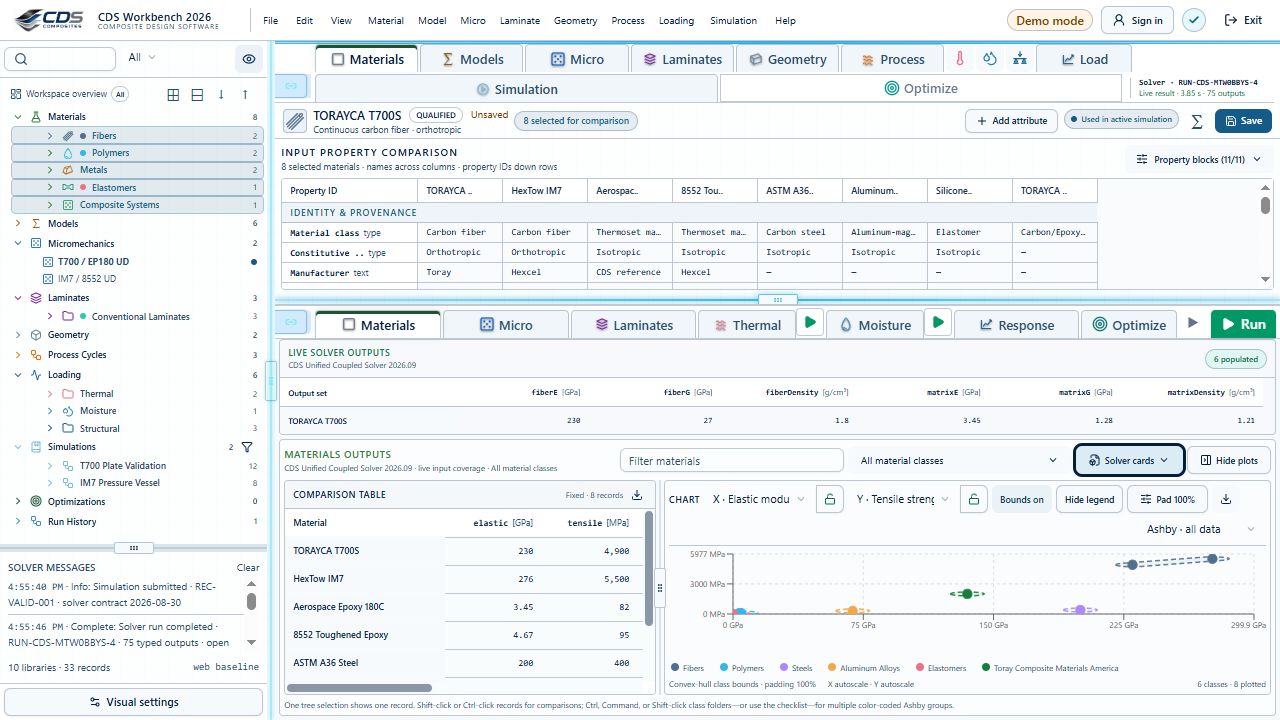
01Source-aware records02Zero-term completion03Table and Ashby comparison
Current CDS Engineering Workbench materials library with a filled comparison table and Ashby chart

CDS / Model hierarchy

One connected model flow.
Materials to processing to design.

Follow material definitions through micromechanics, laminate construction, manufacturing response, structural analysis, and comprehensive database management through all levels.

Select a block to explore its inputs, results and theory. Run the engineering solvers in Workbench.

Materials

Traceable constituent properties

Start with source-aware elastic, strength, density and transport data. Teaching records help you explore; qualified design requires appropriate allowables.

InputFiber, matrix and coreResultTraceable constituent properties
Materials Workbench view

Fatigue is optional and separate from progressive failure. An S–N life prediction is not a stiffness or strength reduction. Finite-plate CLT/FSDT and thick-wall cylinder studies have their own limits; they do not automatically include every process or failure model.

Built for engineering judgment

Layered Data Management Structure

Connected engineering data

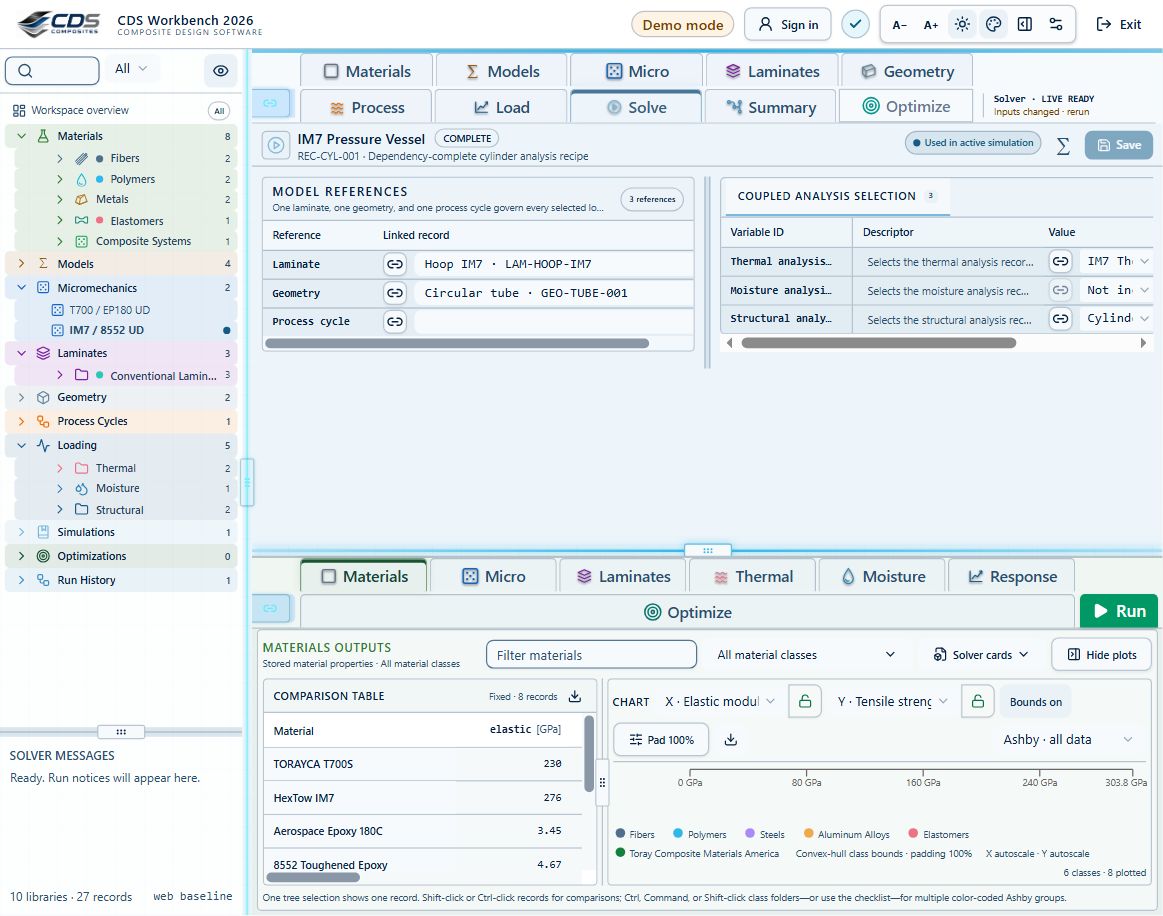
Operate the master tree, bulk moves, multi-count duplication, responsive tabs, local settings, loading, saving, and entity selection from one connected window.

Workbench simulation setup linking laminate, geometry and process records with thermal, moisture and structural analysis selectionsConnected ply editor and colored laminate stack
InputEngineering inputs
ModelConnected model tree
OutputTraceable decisions
Data Management

Material property management

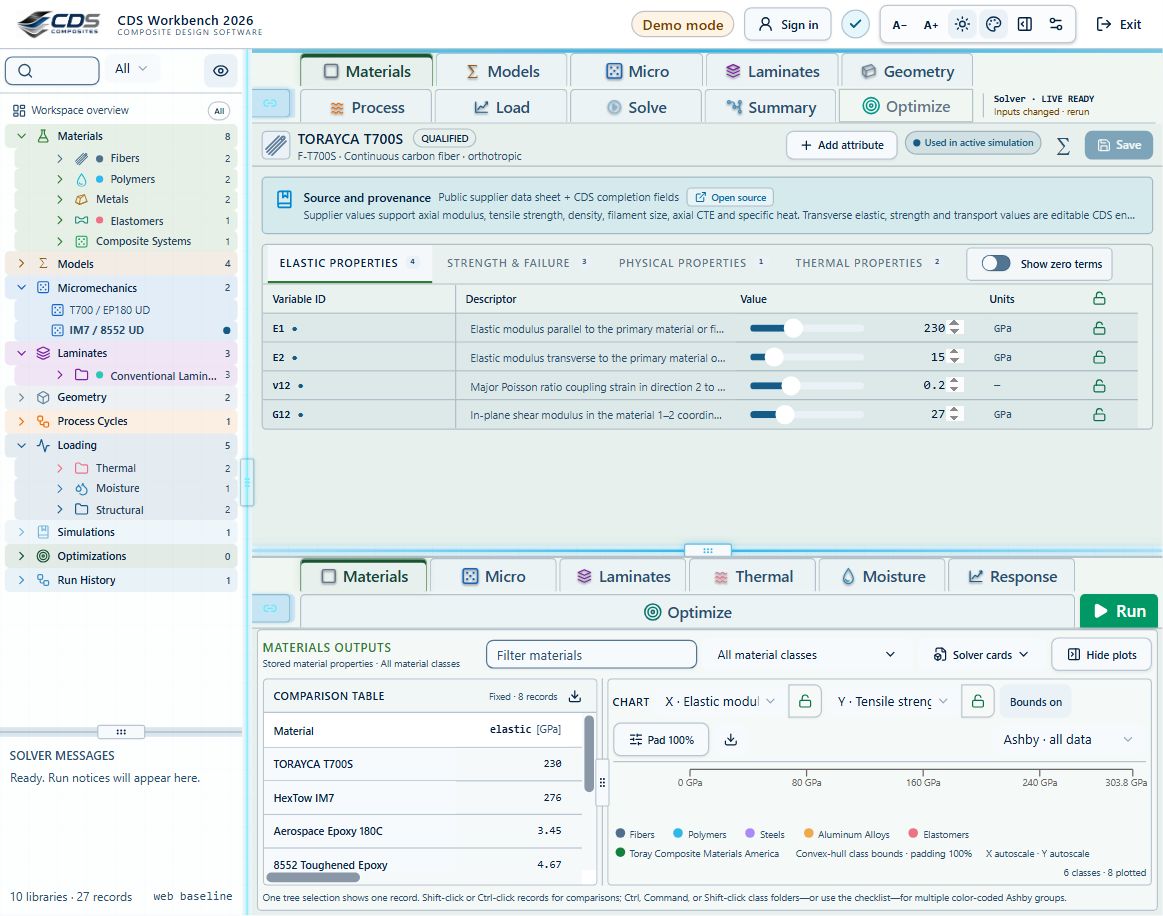
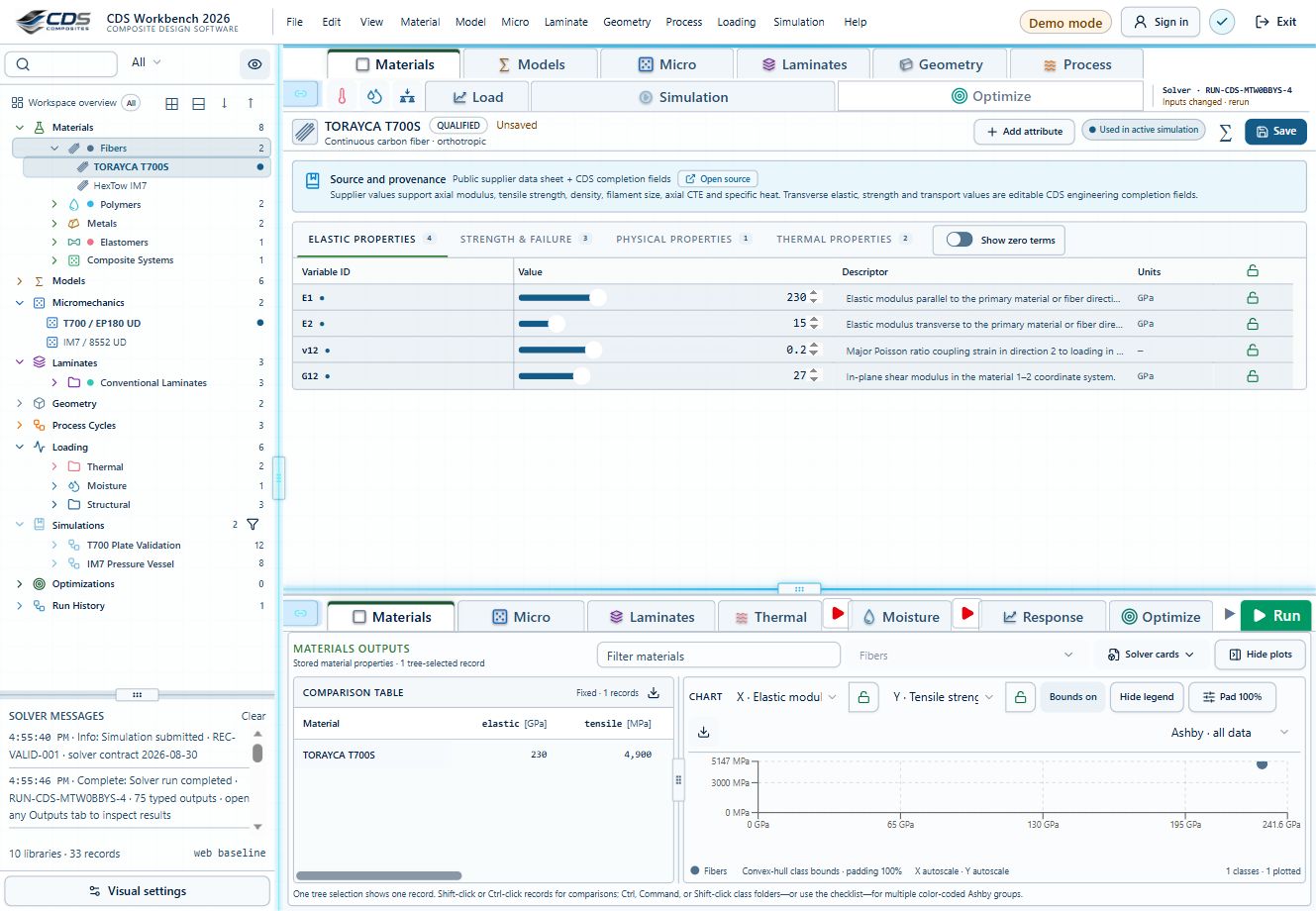
Create source-aware material records with constituent, transport, strength, thermoset cure, thermoplastic crystallization, and editable completion data.

T700S material editor with source provenance, elastic property inputs and material comparison outputsMaterial comparison table and Ashby chart
InputFiber and matrix data
ModelProperty management
OutputReusable material record
Mechanical + thermal

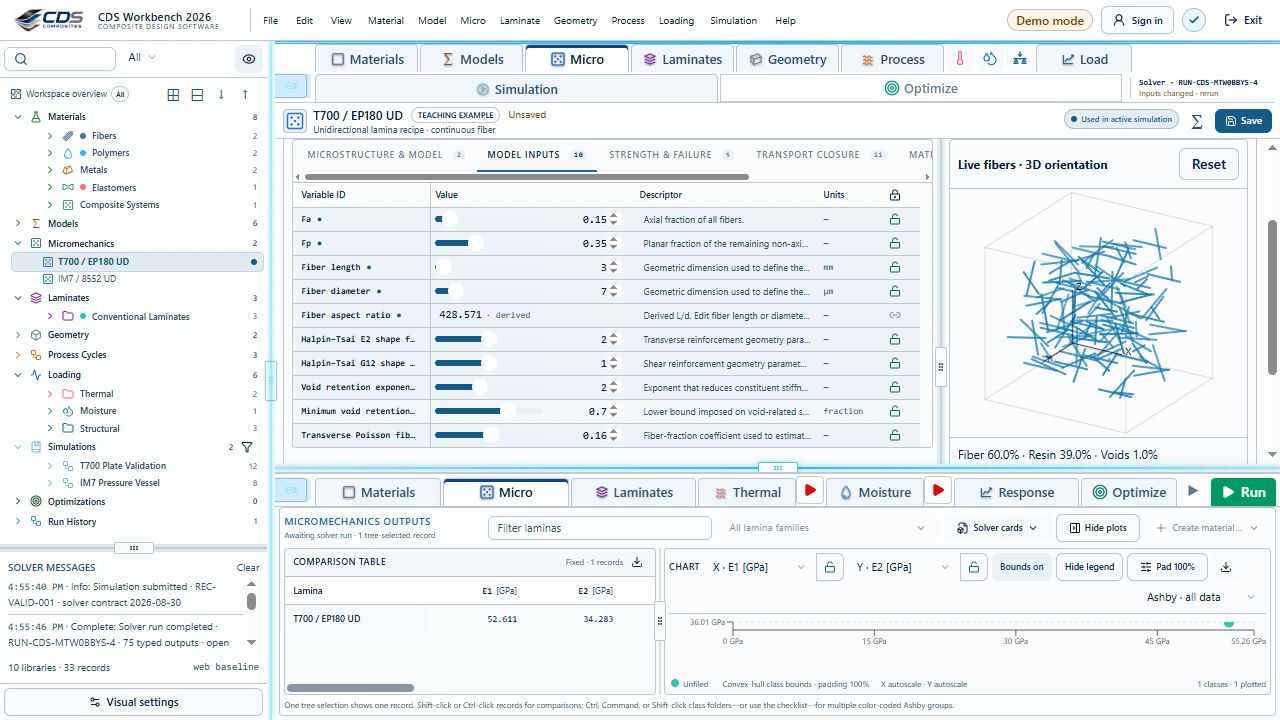
Micromechanics prediction

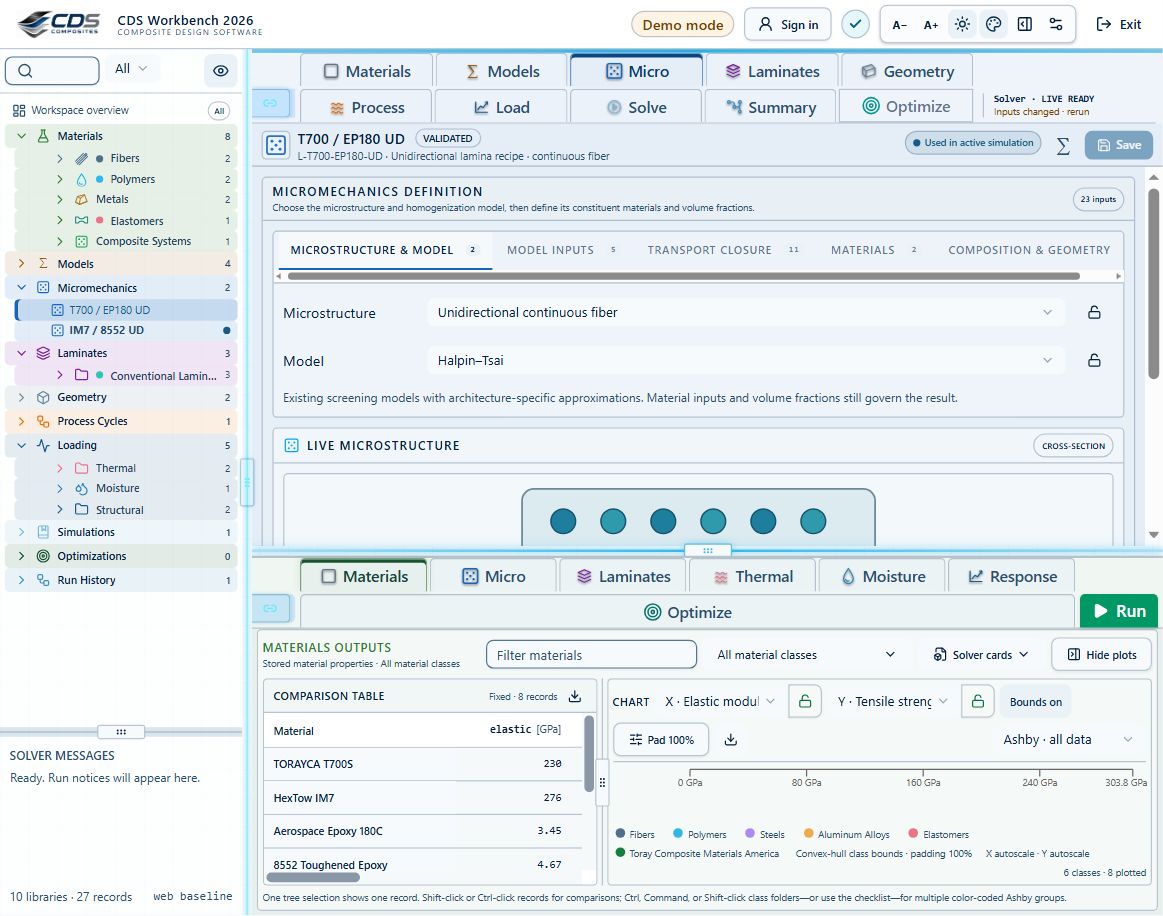
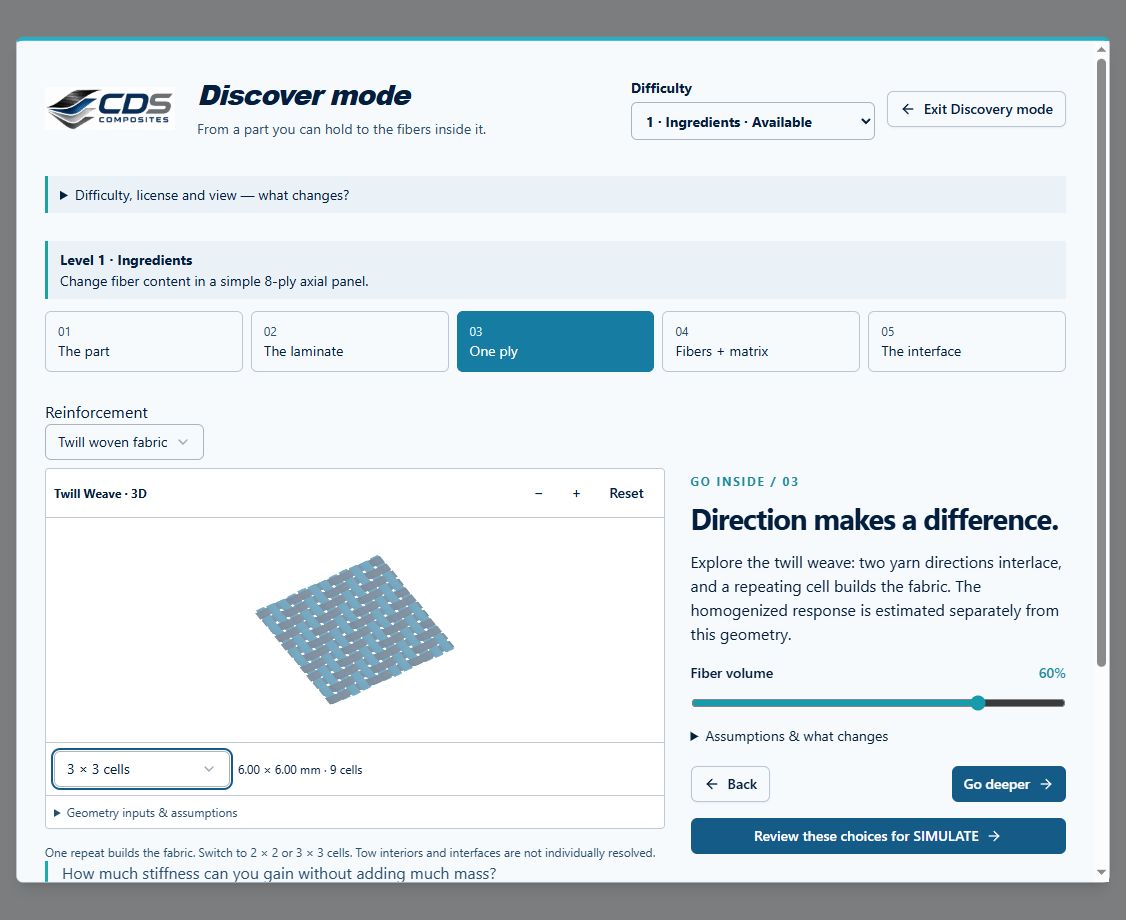
Generate each ply’s complete 3D elastic, strength, expansion, density, and transport definition, then optimize properties against microstructure and model inputs.

Micromechanics controls with unidirectional architecture, Halpin–Tsai selection and a fiber cross-section previewDISCOVER woven fabric GUI with repeating unit cells; illustrative geometry
InputConstituents and architecture
ModelMicromechanics prediction
OutputReusable ply properties
Constituent to ply

Laminate mechanics & failure

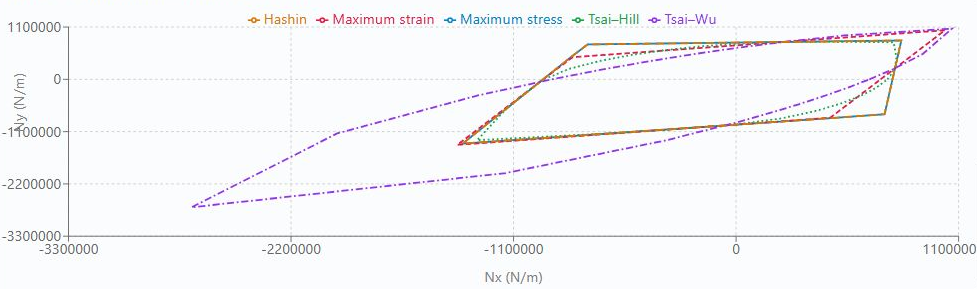
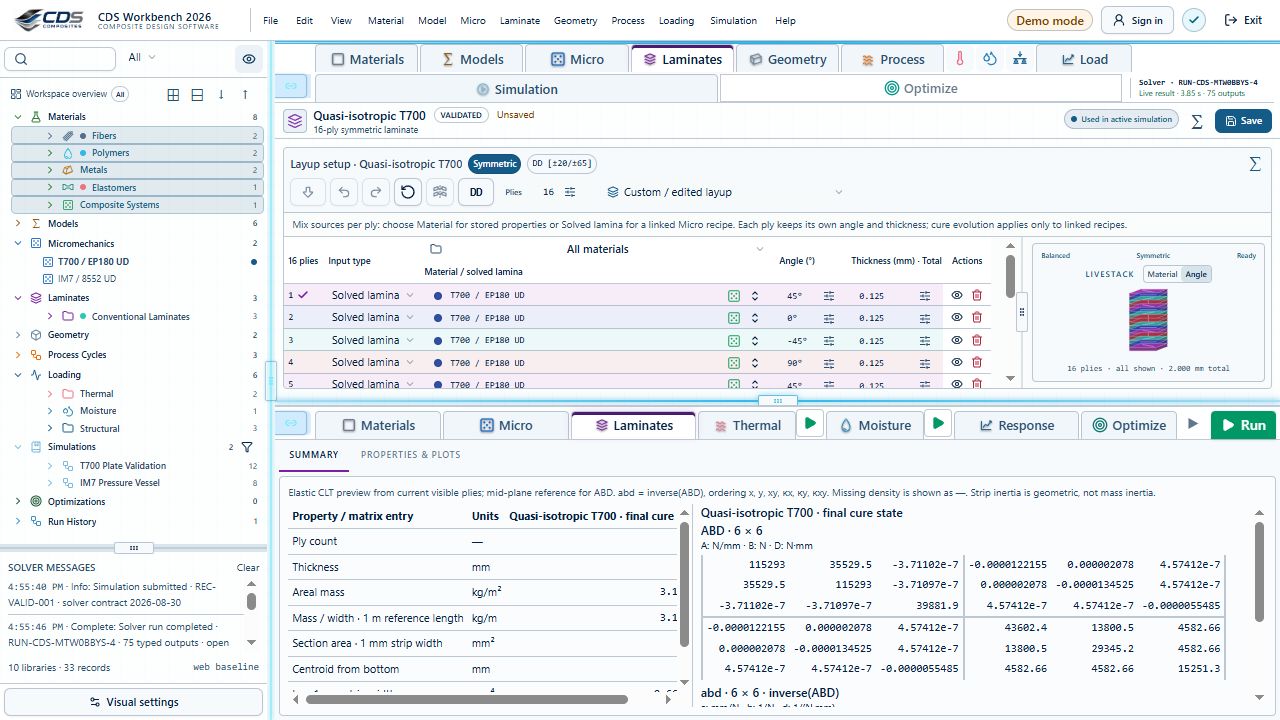
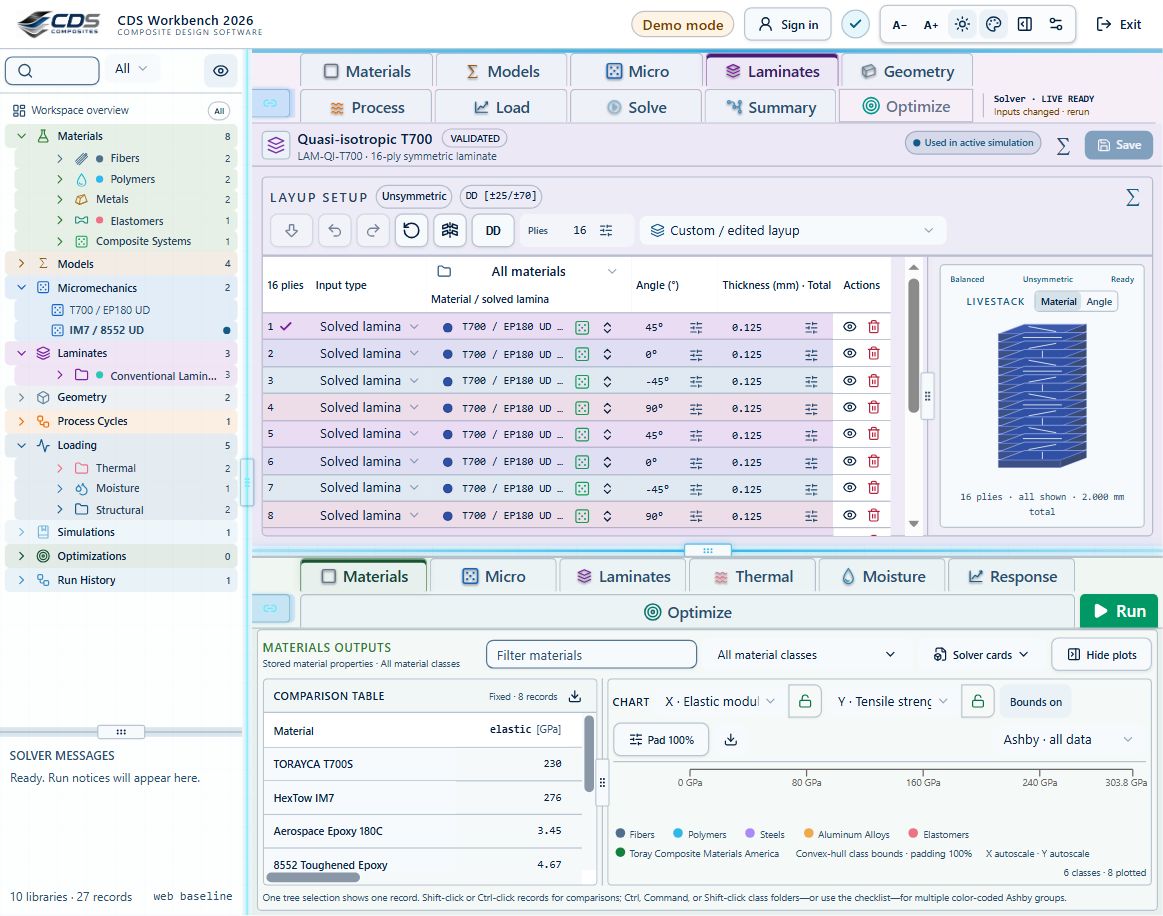
Route each ply independently, then couple ABD response, process residual stress, environmental loading, carpet maps, envelopes, laminate optimization, and progressive failure.

Sixteen-ply laminate editor showing solved-lamina sources, ply angles, thicknesses and the live stackFive-criterion laminate failure envelope
InputPly models, loads, and environment
ModelCoupled progressive failure
OutputFields, properties, and events
Real Time Design

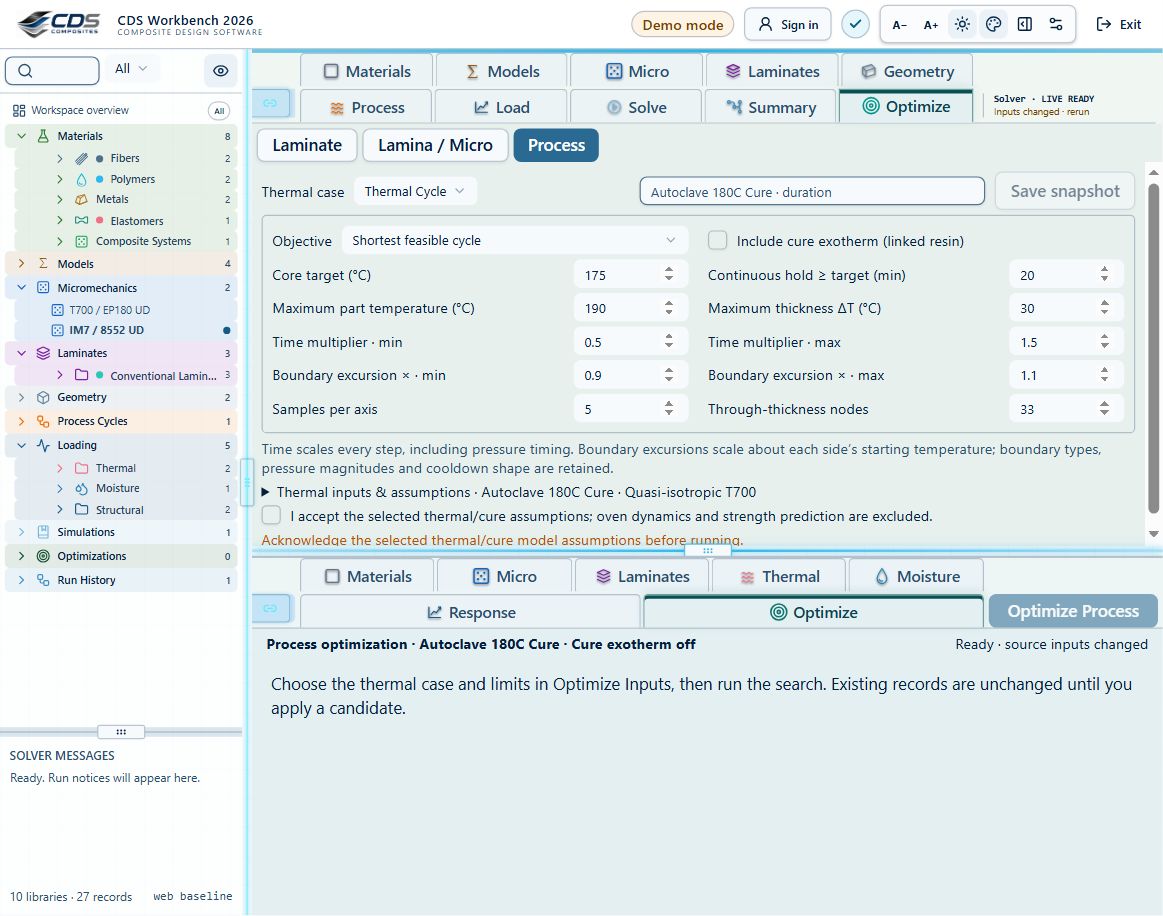
Process & environmental response

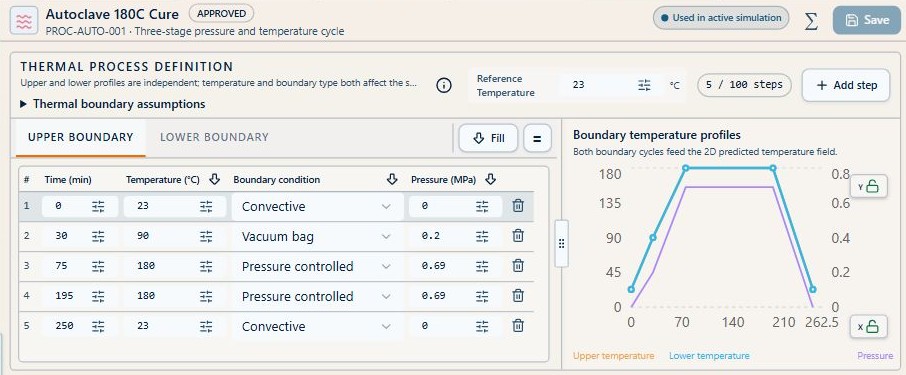
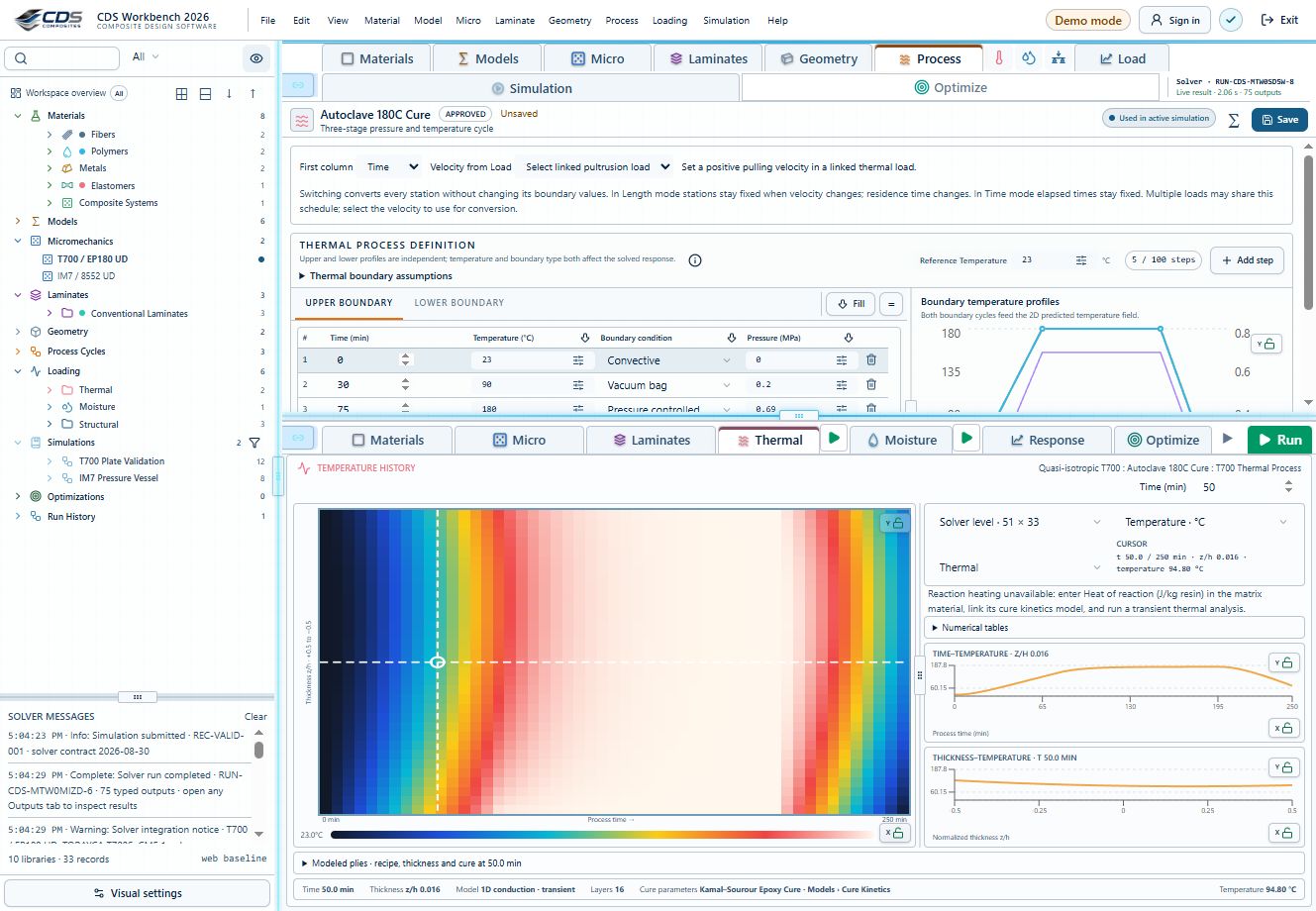
Solve steady-state or transient heat and moisture histories with independent surfaces, cure exotherm, evolving modulus, shrinkage, and process-cycle optimization.

Autoclave process editor with upper and lower boundary tabs, schedule inputs and boundary temperature profilesSolved through-thickness temperature field
InputThermal and moisture history
ModelHeat and diffusion response
OutputThrough-thickness fields
Environmental effects

Structural performance

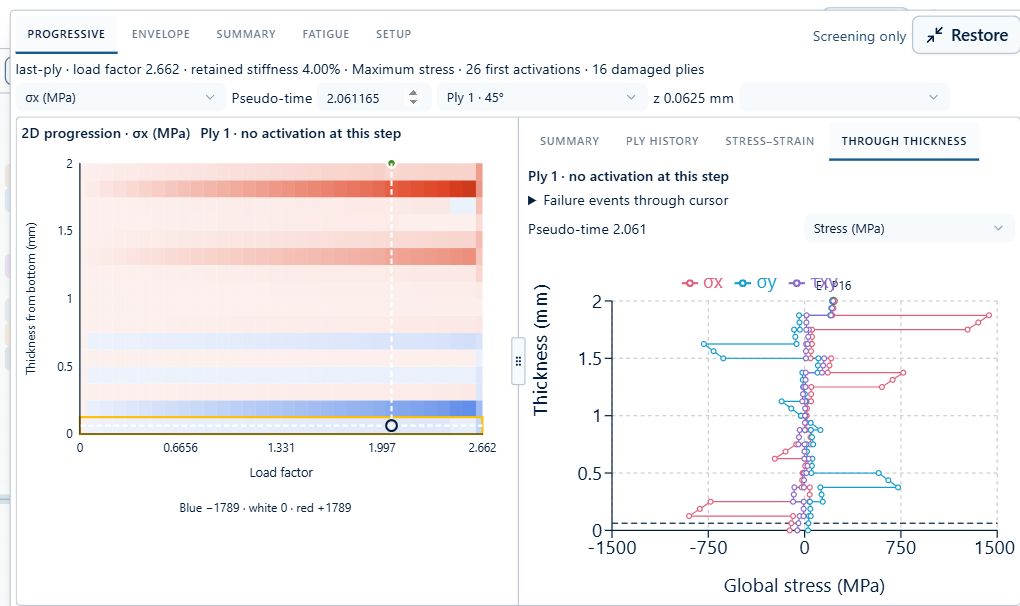
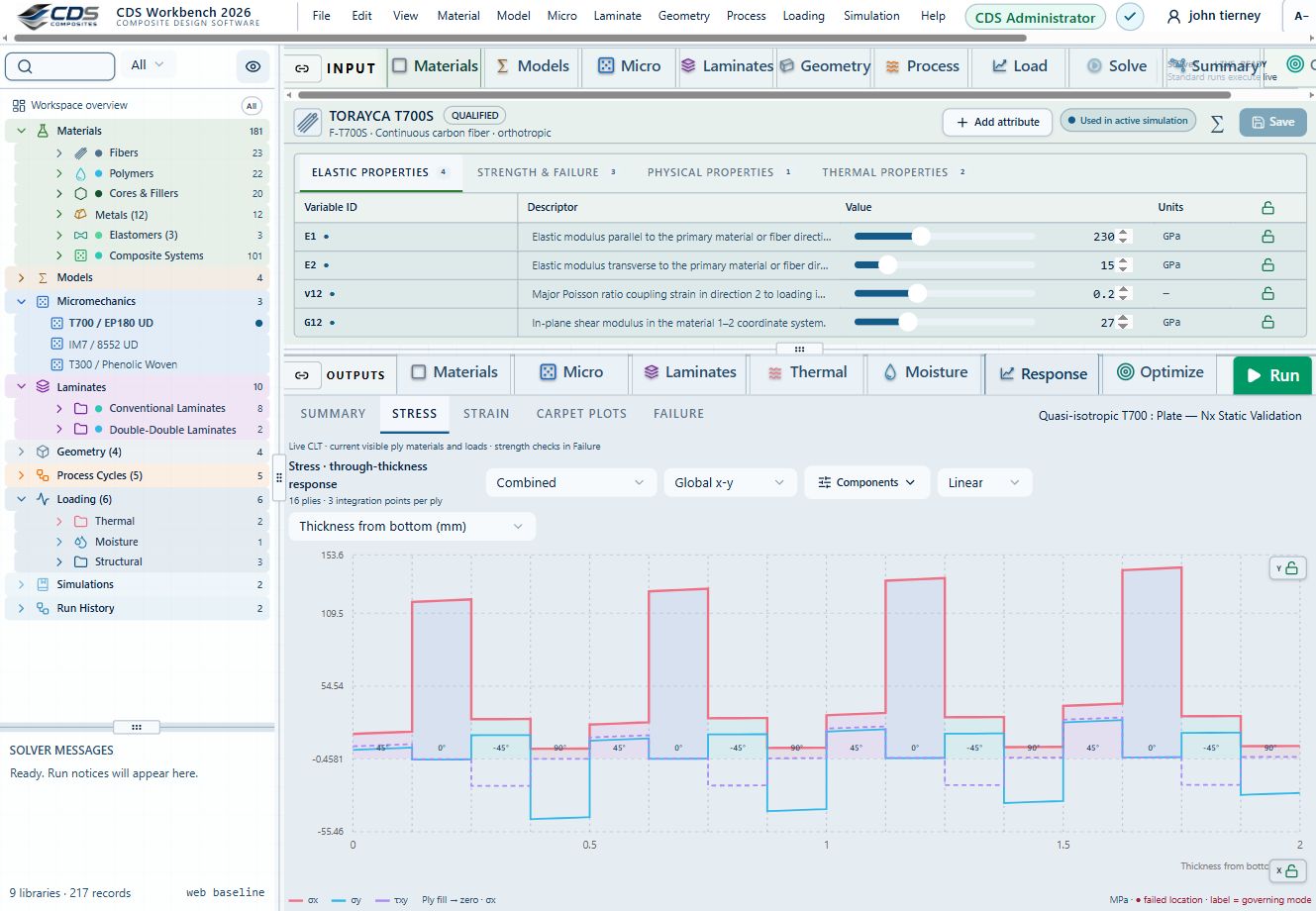
Evaluate supported plate, cylinder, beam, section and joint studies with explicit model limits.

Workbench Response stress view with global component curves across the laminate thicknessReal combined membrane and bending progressive failure with through-thickness stresses
InputGeometry, loading, and supports
ModelStructural mechanics
OutputStress and deformation
Factors of safety

Engineering evidence & automation

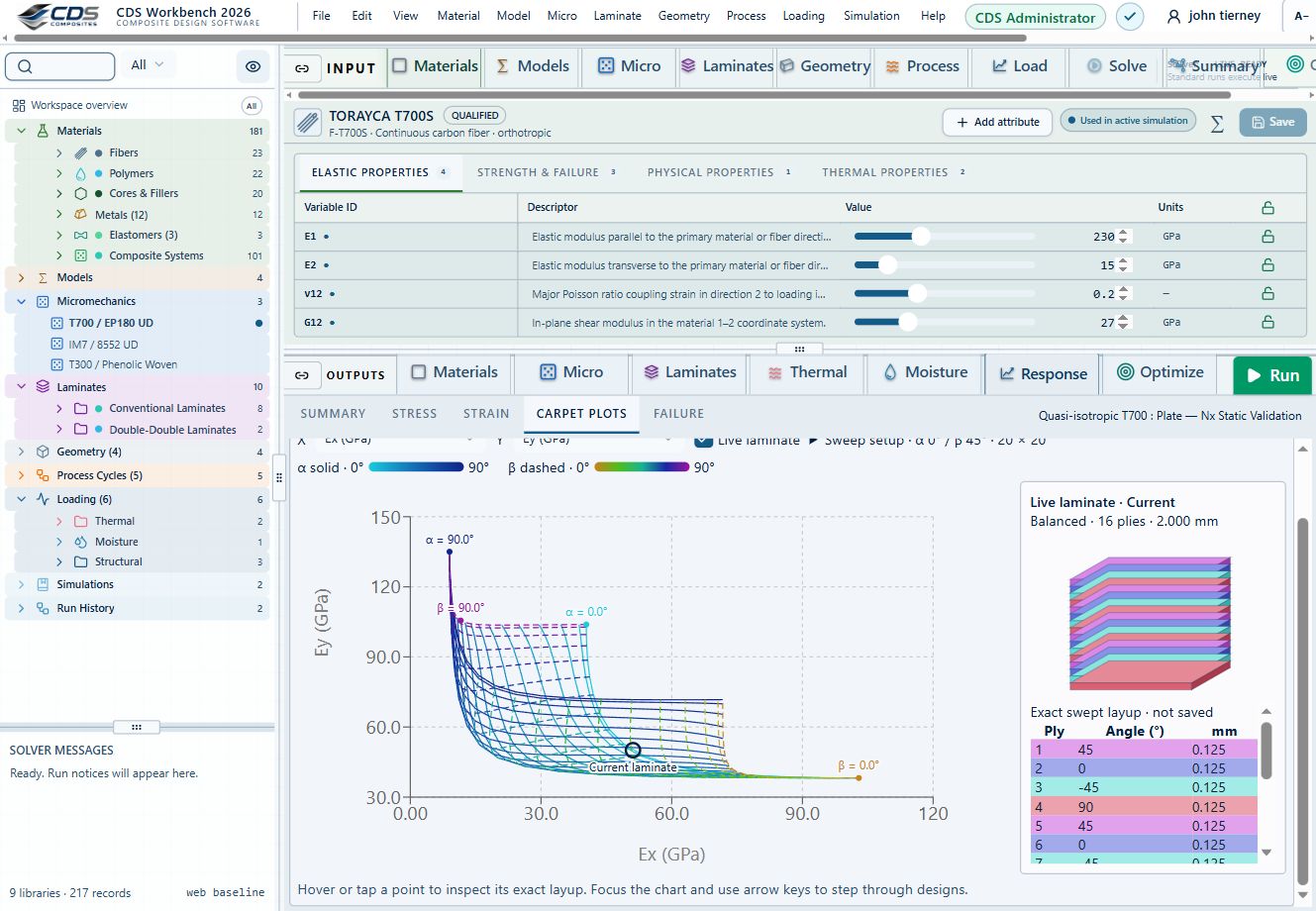
Save optimization snapshots, compare results, automate studies, and export traceable tables and model evidence to common engineering formats.

Laminate Ex–Ey carpet plot with an interactive design point and corresponding live laminate stackSaved process optimization comparison
InputDesign study cases
ModelAutomate and compare
OutputReports and model exports
Repeatable evidence

Integrated composite workflow

Connect materials, micromechanics, laminates, processing, structural analysis, and design decisions in one continuous engineering path.

Workbench simulation setup linking laminate, geometry and process records with thermal, moisture and structural analysis selectionsConnected ply editor and colored laminate stack
InputMaterial and design requirements
ModelConnected CDS workflow
OutputDefensible design evidence
End-to-end engineering

User Manual

Transparent by design.

Composite decisions are only as defensible as the path behind them. CDS keeps that path visible—from source data and constitutive assumptions to every plotted field and exported value.

01Define

Materials, geometry, loads, environment

02Resolve

Mechanics, coupling, failure, uncertainty

03Decide

Trade studies, margins, reports, exports

Help center

Explore our Help Section and User Forums

Use practical guidance for setting up analyses, interpreting results, and resolving common workflow issues—or bring a specialized composite problem directly to the CDS team.

01

CDS User Guide

Learn the recommended sequence for defining materials, selecting a mechanics model, applying loads, and reviewing outputs.

Open the User Guide
02

CDS Theory Manual

Understand the theory, applicability, inputs, and limitations behind each micromechanics, laminate, and bonded-repair method.

∑ Open the Theory Manual
03

CDS Training Manual

Complete the shared Workbench exercises with setup guidance, specific tasks, review checkpoints, model limits and references.

Open all exercises
04Composite theory reference

Technical library

Micromechanics of Composites

Browse the complete web edition covering elastic micromechanics, textile and thermophysical behavior, damage and failure, with equations, assumptions and physical interpretations.

Elastic micromechanicsTextile & thermophysicalDamage & failure
CDS Engineering Workbench validation and model-input interfaceBrowse Micromechanics
0512-section web reference

Technical library

Laminate Analysis

Review Classical Lamination Theory, the ABD matrix, ply-level stress and strain recovery, failure criteria, directional continuum damage, and fatigue model limitations.

CLT & ABDFailure & CDMFatigue & interpretation
CDS Engineering Workbench laminate results and failure summaryBrowse Laminates

Work with CDS

Bring us the composite problem that does not fit in a template.

Request CDS access

Materials · Micromechanics · Laminates · Processing · Design · Custom engineering workflows