
Capabilities / 02.3

Predict effective behavior from
constituents and architecture.

Choose a released architecture-compatible homogenization model, inspect its reference ply properties, and carry those properties into the laminate.
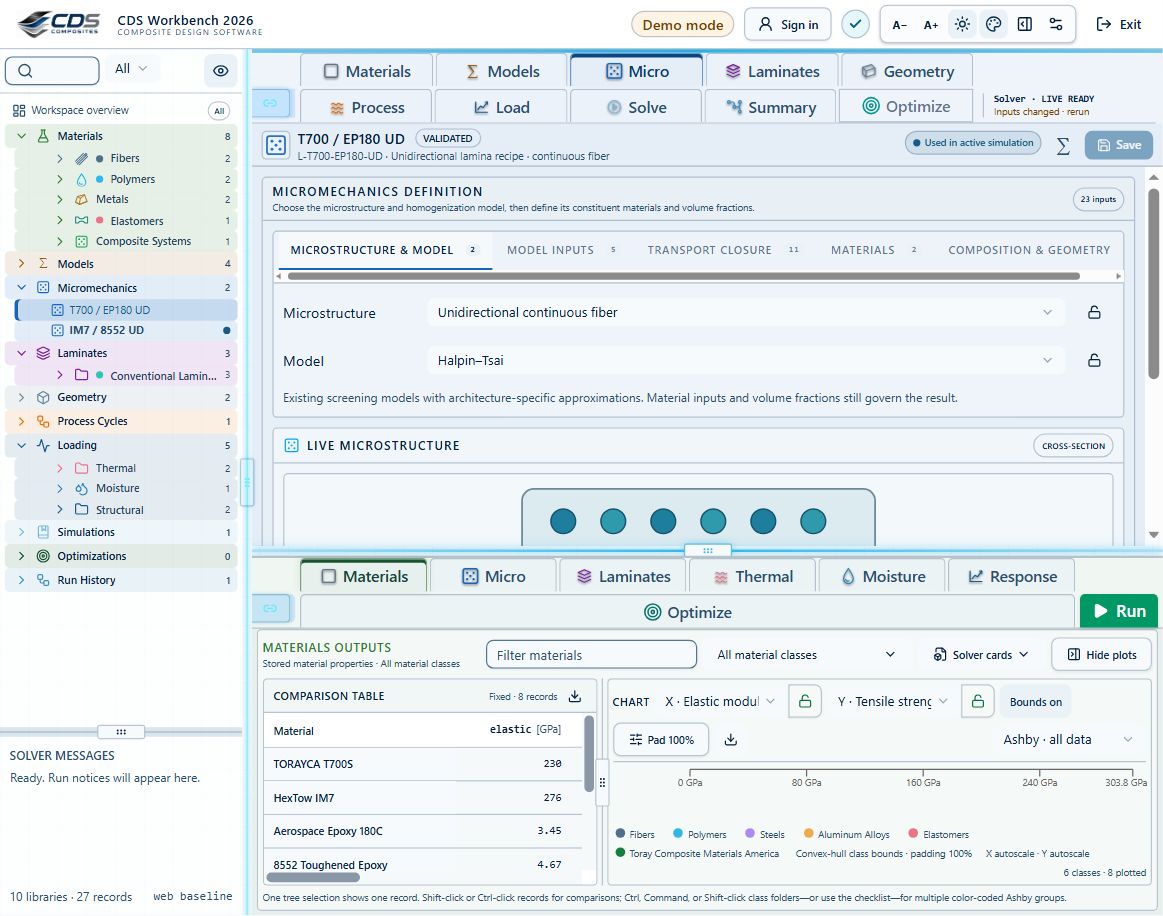
02.3 / Workbench — Micromechanics predictionOpen full-size view ↗
Micromechanics controls with unidirectional architecture, Halpin–Tsai selection and a fiber cross-section preview

Architecture and micromechanics model selections sit beside the live microstructure preview.

Workbench capture · September 7, 2026. Representative interface and demo data, not a new solver run or validation certificate. Control locations may differ in later releases.
Explore fiber volume
Fiber modulus
230 GPa
Matrix modulus
3.5 GPa
Matrix volume
38%
Axial mixture estimate
139.33 GPa
Axial rule of mixturesE₁ = Vf Ef + Vm Em139.33 GPaFiber / matrix / void volume60% / 38% / 2%Idealized UD section · fiber area follows Vf

Zero-stiffness void phase; no empirical void knockdown or transverse prediction.

Teaching illustration only. Controls change this diagram, not your database or Workbench simulation. Ideal axial isostrain estimate with illustrative constituent moduli; not calibrated material allowables.

02.3 / How CDS solves it

From engineering question to evidence
01

Compatible formulations

The Models browser lists rule-of-mixtures variants, Halpin–Tsai, Chamis, Mori–Tanaka, Hashin–Rosen, self-consistent, woven bridging and Cox elastic short-fiber choices. Architecture determines which choices are available.

02

Short-fiber scope

Cox shear-lag elastic studies use prescribed geometry and orientation. The event-driven Henry–Pimenta RVE and its stochastic discontinuous-fiber failure route are not enabled in the hosted release.

03

Ply-property handoff

The selected Micro recipe supplies reference properties to its linked plies. Shared material or Micro edits can change multiple laminate calculations.

04

Explore and compare

Use an exercise or supported property sweep to compare model assumptions, constituent limits and sensitivity. Predicted strengths and teaching defaults are not qualified allowables.

Released models, connections and theory

Complete model directory ↗

Micromechanics

Models browser → Micromechanics · source: Micro

InputsConstituents, architecture, fractions and calibrated modifiersResults / handoffReference ply properties for each linked laminate ply

One compatible homogenization model per Micro recipe. Use separate recipes for comparisons; they are not combined in a single ply.

Formulations and study choices
  • Halpin–Tsai
  • Rule of mixtures
  • Modified rule of mixtures
  • Chamis
  • Mori–Tanaka
  • Hashin–Rosen
  • Self-consistent scheme
  • Woven fabric bridging
  • Cox shear-lag elastic
Wiener series and parallel

Models → Electromagnetics · RF → Wiener series and parallel

InputsExplicit host/inclusion electrical properties and fractionsResults / handoffEffective permittivity; manual handoff to an RF layer, not an automatic mechanical-property update

Positive lossless dielectric bounds; complex directional estimates.

Formulations and study choices
  • EM · Wiener series and parallel
Looyenga / Landau–Lifshitz–Looyenga

Models → Electromagnetics · RF → Looyenga / Landau–Lifshitz–Looyenga

InputsExplicit host/inclusion electrical properties and fractionsResults / handoffEffective permittivity; manual handoff to an RF layer, not an automatic mechanical-property update

One cube-root mixing law, not two independent models.

Formulations and study choices
  • EM · Looyenga / Landau–Lifshitz–Looyenga
Maxwell–Garnett

Models → Electromagnetics · RF → Maxwell–Garnett

InputsExplicit host/inclusion electrical properties and fractionsResults / handoffEffective permittivity; manual handoff to an RF layer, not an automatic mechanical-property update

Dilute subwavelength spherical inclusions in a host.

Formulations and study choices
  • EM · Maxwell–Garnett
Bruggeman symmetric EMT

Models → Electromagnetics · RF → Bruggeman symmetric EMT

InputsExplicit host/inclusion electrical properties and fractionsResults / handoffEffective permittivity; manual handoff to an RF layer, not an automatic mechanical-property update

Two positive-permittivity phases; no explicit contact network.

Formulations and study choices
  • EM · Bruggeman symmetric EMT
EM Mori–Tanaka

Models → Electromagnetics · RF → EM Mori–Tanaka

InputsExplicit host/inclusion electrical properties and fractionsResults / handoffEffective permittivity; manual handoff to an RF layer, not an automatic mechanical-property update

Scalar principal-axis ellipsoidal field approximation.

Formulations and study choices
  • EM · EM Mori–Tanaka
EM self-consistent

Models → Electromagnetics · RF → EM self-consistent

InputsExplicit host/inclusion electrical properties and fractionsResults / handoffEffective permittivity; manual handoff to an RF layer, not an automatic mechanical-property update

Scalar principal-axis self-consistency; spherical case equals Bruggeman.

Formulations and study choices
  • EM · EM self-consistent
Differential effective medium

Models → Electromagnetics · RF → Differential effective medium

InputsExplicit host/inclusion electrical properties and fractionsResults / handoffEffective permittivity; manual handoff to an RF layer, not an automatic mechanical-property update

Incremental mixing with time-step refinement check.

Formulations and study choices
  • EM · Differential effective medium
Coated sphere and interphase

Models → Electromagnetics · RF → Coated sphere and interphase

InputsExplicit host/inclusion electrical properties and fractionsResults / handoffEffective permittivity; manual handoff to an RF layer, not an automatic mechanical-property update

Concentric subwavelength coated spheres; no dynamic Mie scattering.

Formulations and study choices
  • EM · Coated sphere and interphase
Generalized multiphase EMT

Models → Electromagnetics · RF → Generalized multiphase EMT

InputsExplicit host/inclusion electrical properties and fractionsResults / handoffEffective permittivity; manual handoff to an RF layer, not an automatic mechanical-property update

Spherical multiphase Bruggeman with convergence checks.

Formulations and study choices
  • EM · Generalized multiphase EMT

Outcomes and boundaries

  • One compatible model is selected per Micro recipe; models are not blended.
  • Cox short-fiber predictions are elastic. Event-driven RVE and stochastic discontinuous-fiber failure remain disabled.
  • Calibration and constituent-limit checks are required before engineering use.

Delivered capability

Methods available in CDS
01

Architecture-compatible model selection

02

Constituent references, volume fractions and supported geometry / orientation controls

03

Reference elastic, density and supported thermophysical properties

04

Linked ply-property handoff to Laminates

05

Model-relevant sweeps and saved comparisons

Next capability02.4 Laminate mechanics & failure