
04.7.1 / CDS User Guide
Video archive
historical reference only.
Archived September 10, 2026. These older screenshots and instructions do not represent the current release. The original pilot is an interactive slide guide, not a recorded video.
Complete manuals · download a whole collection
Each collection includes an editable Word manual and its matching searchable PDF, with linked contents, explanatory text, diagrams and references. Theory equations use native Word mathematics. Individual-page PDF buttons remain available.
These are dated reading editions of the public learning content. Interactive studies and account-controlled classroom notes and databases stay online. For current changes, follow the chapter links back to the website.
Current Workbench, reference editions and downloads
Use the online User Guide for current controls, the released model directory for selectable models and compatibility, and the Training Manual for connected exercises. Wider theory references do not mean every formulation is enabled in Workbench.
Dated GUI captures and compiled Web r18 PDF manuals retain their stated scope; they are not a substitute for current hosted Workbench instructions. Find the overview PDF, guides and exercise databases in Your CDS library.
← Current video status · Use the current exercise manual
Archived pilot · Historical interactive walkthrough
Compare materials and build an Ashby view
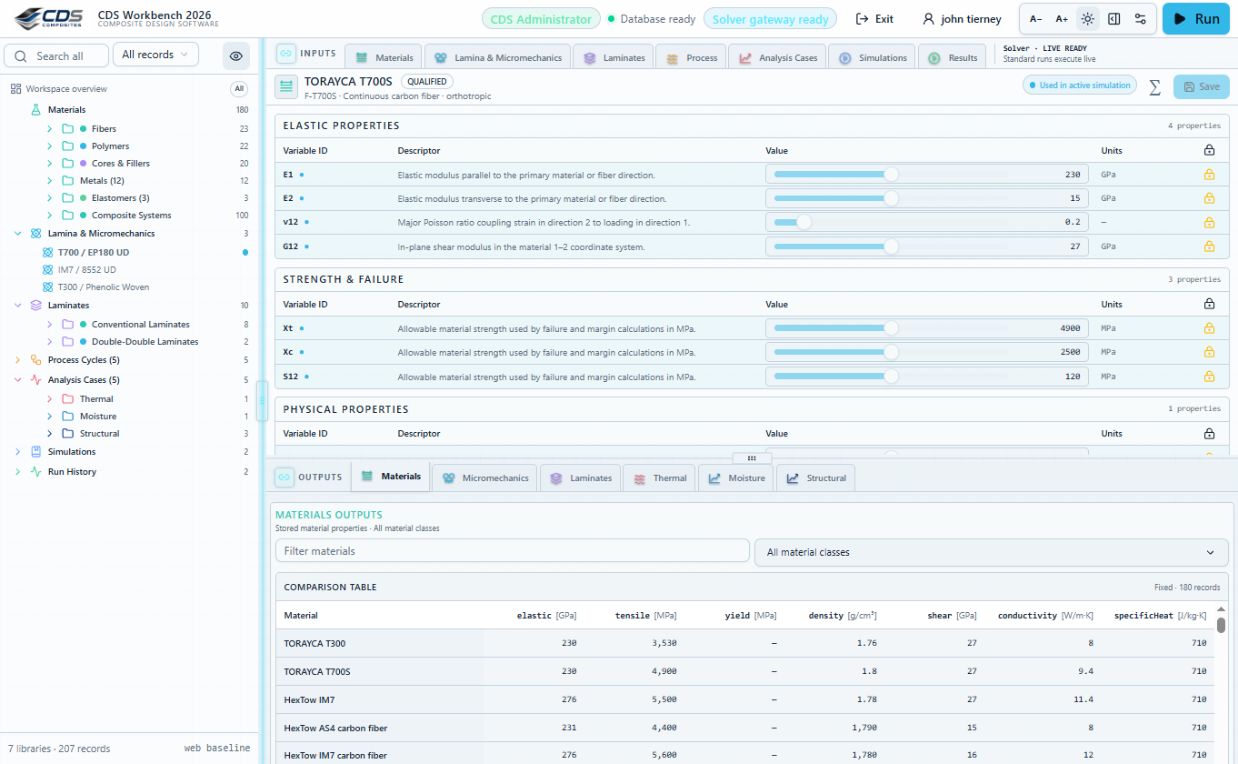
Open Materials and confirm the database and solver indicators. Inputs remain above the divider; the Materials comparison table and chart remain available below it.
Read transcript and verification notes
1. Orient the workspace
Open Materials and confirm the database and solver indicators. Inputs remain above the divider; the Materials comparison table and chart remain available below it.
Verify: Confirm the Workbench mode and database source before interpreting stored properties.
2. Plot a material class
Select the Fibers class in the project tree. The comparison table is fixed on the left and the chart defaults to an Ashby view of the selected class.
Verify: The output header should read Fibers and the record count should reflect the entire class.
3. Compare two records
Select TORAYCA T700S, then Shift-click HexTow IM7. Material names become columns and property IDs become rows so values, units, identity, and provenance can be compared directly.
Verify: Verify both record names, manufacturer fields, record revisions, and primary sources before comparing values.
4. Read the Ashby plot
Read elastic modulus on the horizontal axis in gigapascals and tensile strength on the vertical axis in megapascals. The selected records stay synchronized between the table and chart.
Verify: Ellipses summarize class spread and orientation; they are comparison aids, not design allowables or qualification limits.
All exercises, case studies and simulation examples → · Your CDS library: overview, manuals and database downloads →