
Center for Composite Materialsfin
Login/Register→
CREATEDISCOVERSIMULATE
01Overview↗
01.4Why composites? · Live study↗
01.1What's New↗
01.2Gallery↗
01.3About↗
02Capabilities↗
02.1Connected engineering data↗
02.2Material property management↗
02.3Micromechanics prediction↗
02.4Laminate mechanics & failure↗
02.5Process & environmental response↗
02.6Structural performance↗
02.7Engineering evidence & automation↗
03Workflow↗
03.1Materials↗
03.2Micromechanics↗
03.3Laminates↗
03.4Processing↗
03.5Design↗
03.6Cloud↗
03.7Released models & connections↗
04CDS User Guide↗
04.1Getting Started↗
04.2Workspace & Navigation↗
04.3Materials↗
04.3.2Edit Properties↗
04.3.3Move & Organize↗
04.3.4Duplicate & Delete↗
04.3.5Right-Click Options↗
04.4Laminas & Laminates↗
04.5Processes & Simulations↗
04.6Interface & Effective Use↗
04.10Connected Workbench & Live Sync↗
04.11Failure, Design Maps & Optimization↗
04.7Videos↗
04.7.1Video archive (historical)↗
05CDS Theory Manual↗
05.1Materials↗
05.1.1Thermoset Cure Kinetics↗
05.1.2Thermoplastic Crystallization↗
05.2Micro↗
05.2.1Elastic Micromechanics Theory↗
05.2.2Aligned Discontinuous-Fiber Model↗
05.2.3Textile and Thermophysical Framework↗
05.2.4Fabric Micromechanics Theory↗
05.2.5Warp–Weft Averaging and Crimp Correction↗
05.2.6Filled Matrix, Hybrid, and Void Micromechanics↗
05.2.7Effective Density and Specific Heat↗
05.2.8Thermal Conductivity Micromechanics↗
05.2.9CTE Micromechanics↗
05.2.10Orthotropic Thermophysical Property Assembly↗
05.2.11Verification, Validation, and References↗
05.2.12Damage, Failure, and Implementation Framework↗
05.2.13Continuum Damage Mechanics↗
05.2.14Composite Failure Criteria↗
05.2.15Damage and Failure Workflow↗
05.3Laminates↗
05.3.1Framework & Scope↗
05.3.2Ply Property Definition↗
05.3.3Material Routing↗
05.3.4Failure Criteria↗
05.3.5Hygrothermal CLT & ABD↗
05.3.6Progressive Failure↗
05.3.7Damage Redistribution↗
05.3.8Effective Properties↗
05.3.9Cohesive Delamination↗
05.3.10Verification & Validation↗
05.3.11Assumptions & Limitations↗
05.3.12Theory References↗
05.3.13Workbench Methods & Limits↗
05.4Thermal↗
05.4.1Thermal Conductivity↗
05.4.2Thermal Expansion↗
05.4.3Laminate Thermal Response↗
05.4.4Transient Heat & Boundaries↗
05.4.5Thermoset Cure Models↗
05.4.6Thermoplastic Crystallization↗
05.5Moisture↗
05.5.1Moisture Diffusion↗
05.5.2Hygrothermal Formulation↗
05.5.3Effective Properties↗
05.5.4Assumptions & Limits↗
05.6Structural↗
05.6.1Structural Framework↗
05.6.2Constant-Section Shell Cylinder↗
05.6.3Hyer Thick Cylinder↗
05.6.4Process Coupling↗
05.6.5Plate, Cylinder & Beam Models↗
05.6.6FSDT↗
05.6.7Fatigue↗
05.6.8Advanced Models↗
05.6.9Virtual Tests↗
05.6.10Failure Assessment↗
05.6.11Verification & Validation↗
06CDS Training Manual↗
06.1All exercises · guided curriculum↗
06.2Case Studies↗
06.2.1Lamina Analysis↗
06.2.2Laminate Design↗
06.2.3Process Cure Study↗
06.2.4Structural Pressure Analysis↗
06.3Examples↗
06.3.1Micromechanics↗
06.3.2Laminates↗
06.3.3Analyses↗
06.3.4Starter Files↗
06.4Instructor sessions · licensed↗
06.4.1Navigation Foundations↗
06.4.2Material Navigation↗
06.4.3Micromechanics↗
06.4.4Lamina & Laminate↗
06.4.5Thermal Processing↗
06.4.6Structural Analysis↗
07Contact↗08Forum↗

CDS software in action

Overview / Gallery

See the software
in action.

Explore the current browser-based CDS Engineering Workbench across traceable records, multiscale models, process and structural simulation, optimization, and reusable results.

Interface gallery

6 workflow views
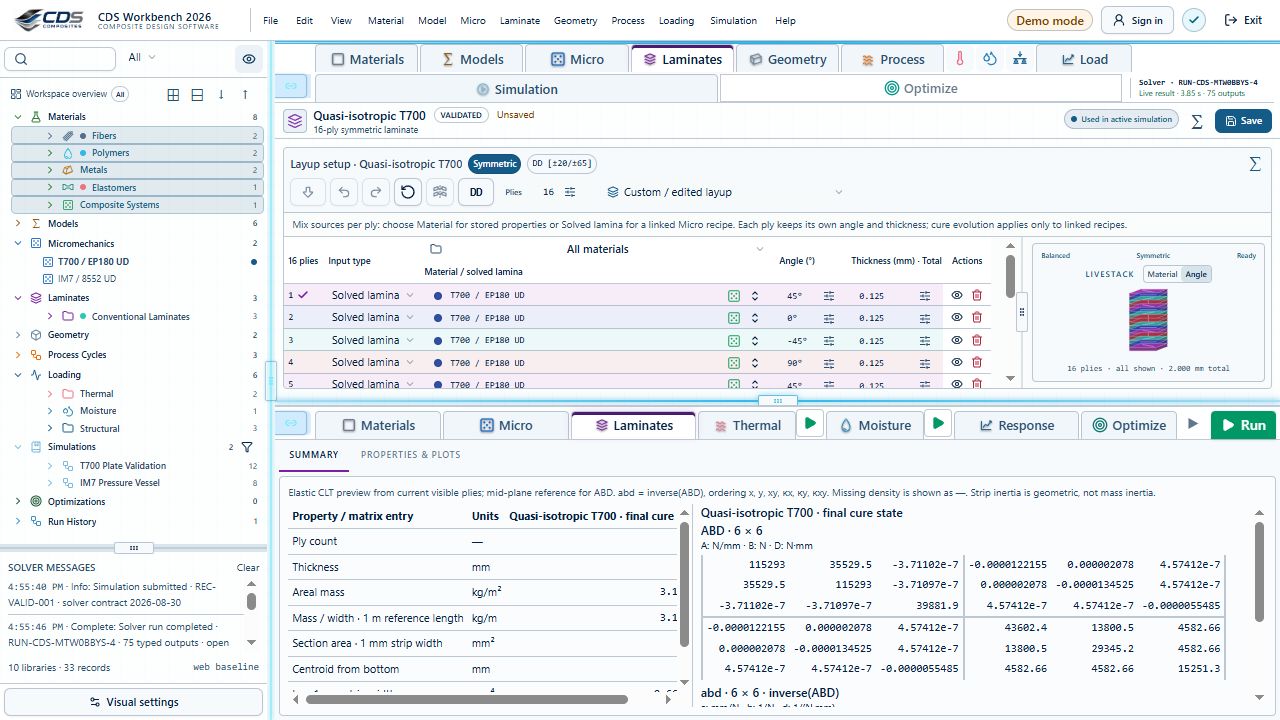
Light-mode laminate ply editor, angle-colored live stack and ABD properties
01

Connected laminate workspace

A 16-ply laminate using a linked Micro recipe. The live stack is colored by ply angle, alongside the shared CLT properties.

Open full-size GUI ↗
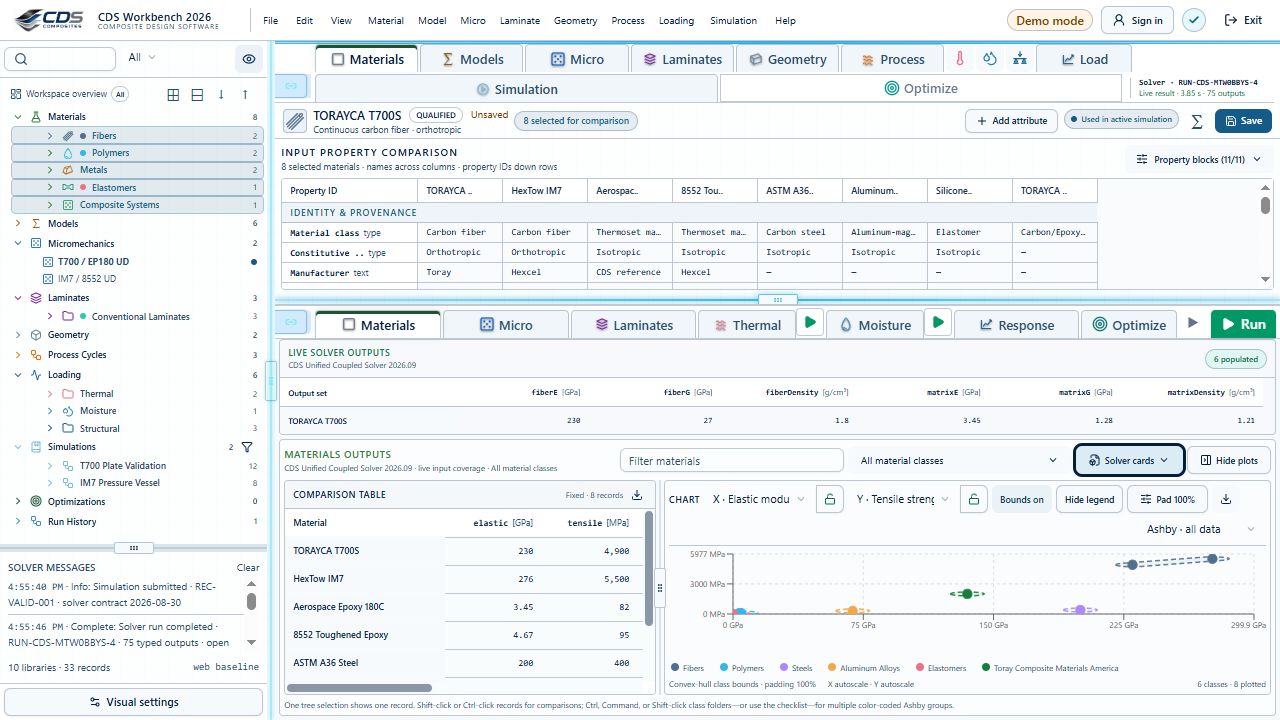
Light-mode material comparison with eight records and colored Ashby groups
02

Materials and Ashby comparison

Eight selected reference records populate the comparison table and material-class plot. Sources and screening values must still be checked for design use.

Open full-size GUI ↗
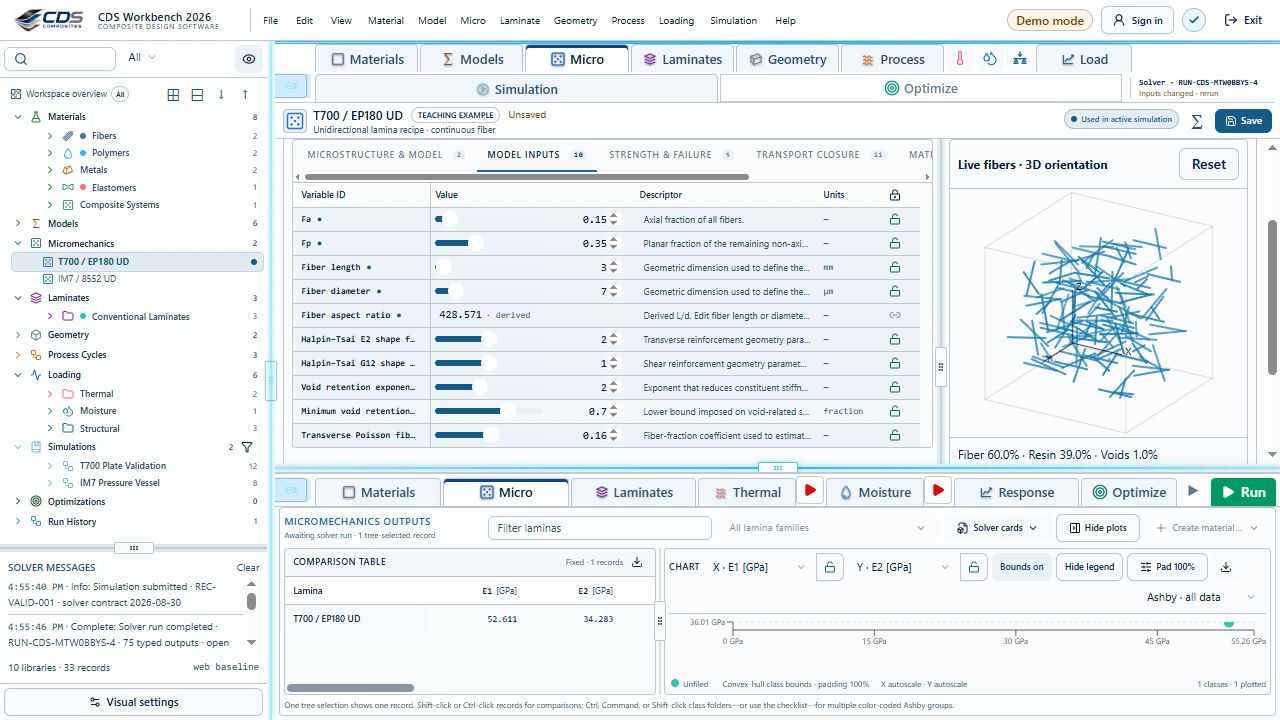
Actual short-fiber GUI with orientation inputs and a spatially distributed fiber preview
03

Random short-fiber orientation

Cox shear-lag teaching setup with Fa = 0.15 and Fp = 0.35. The 3D illustration uses normalized fiber lengths; it is not a resolved RVE or a physical-scale micrograph.

Open full-size GUI ↗
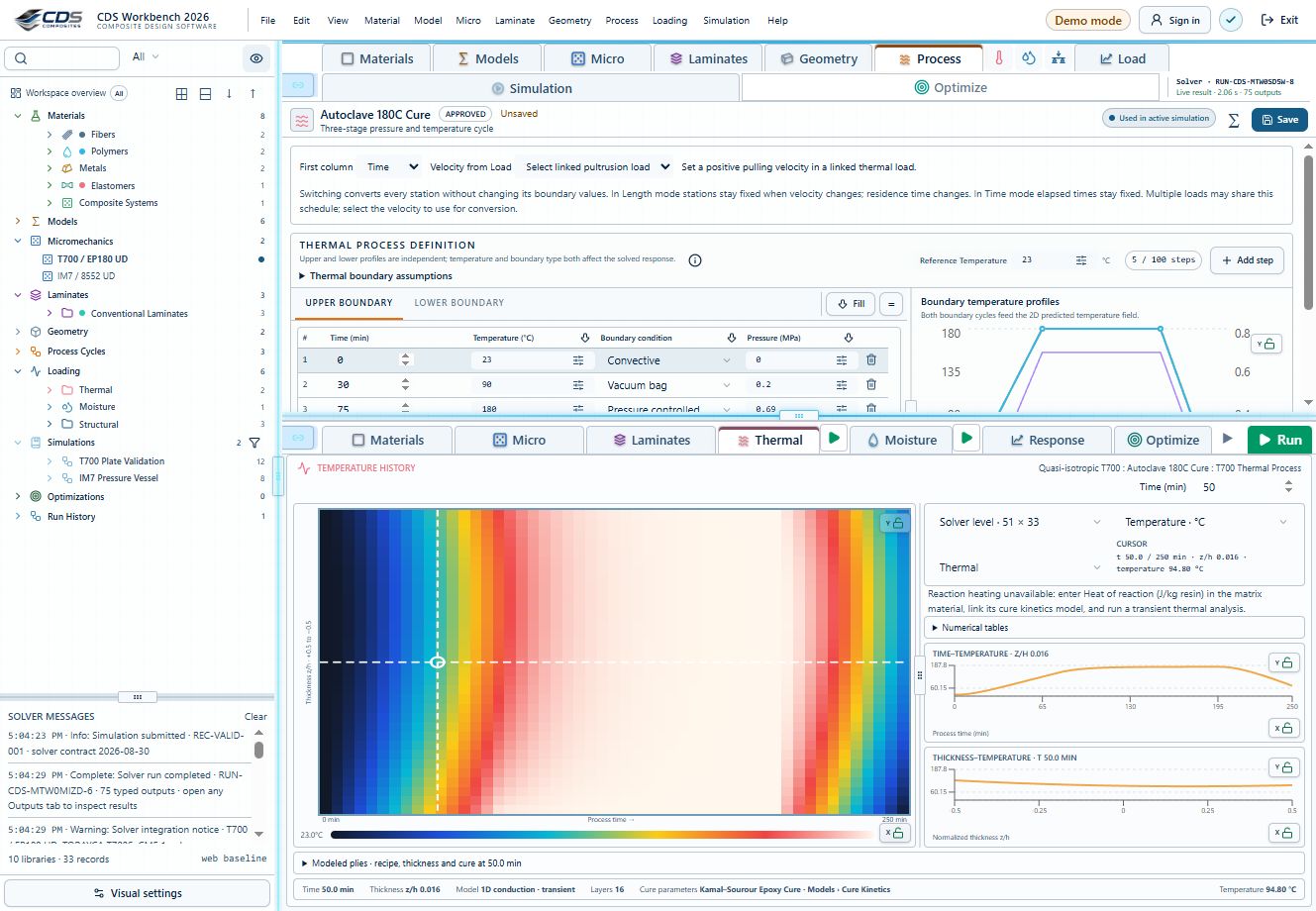
Light-mode thick-laminate temperature field, heating history and through-thickness section
04

Thick-section thermal lag

A 64-mm, 16-layer teaching variation of the local T700 demo, with a heating-ramp cursor and through-thickness section. Conduction demonstration only: the GUI reports missing reaction-heating data. Not a NASA benchmark or a qualified cure cycle.

Open full-size GUI ↗
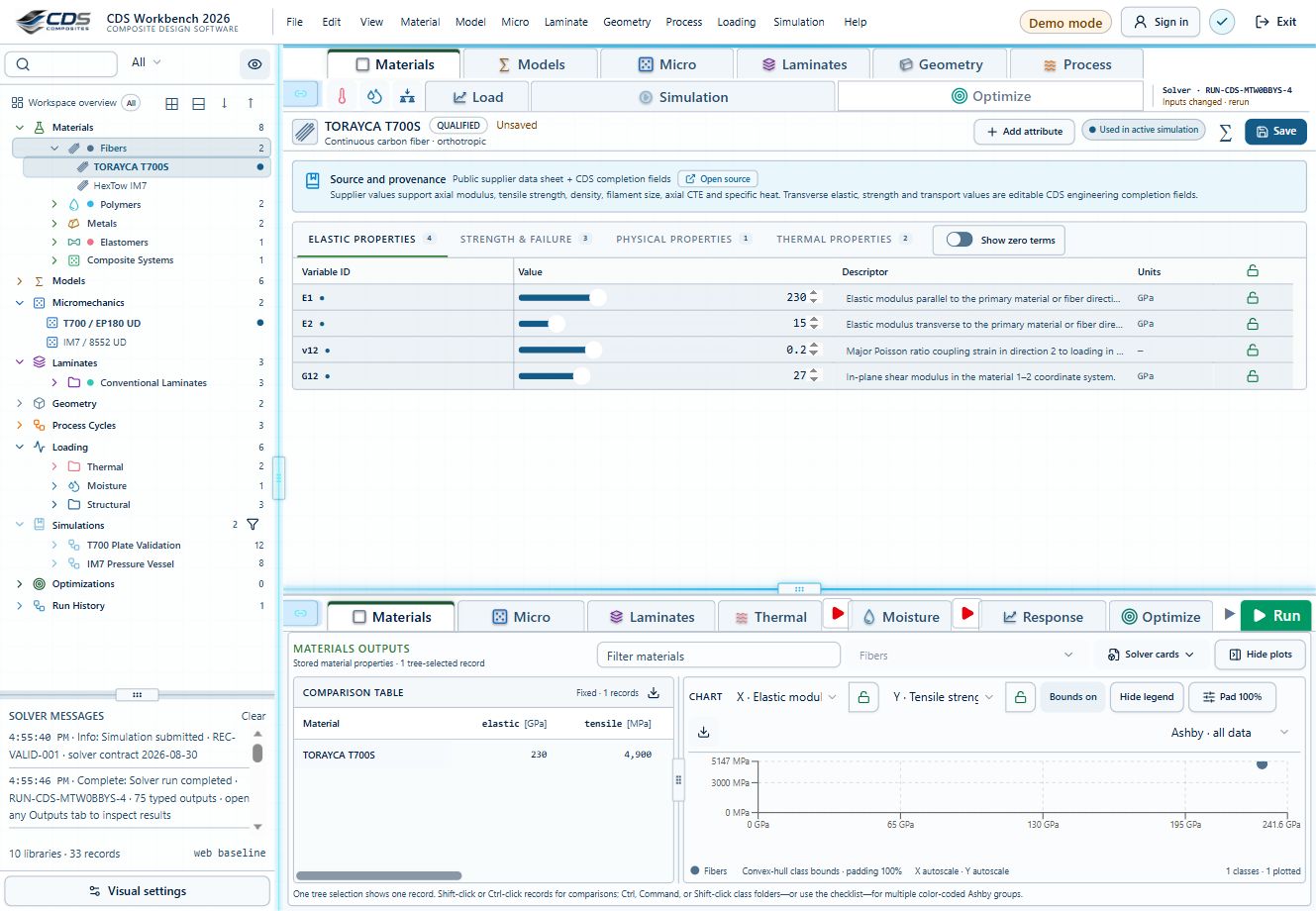
Light-mode T700S material record with supplier provenance and editable elastic properties
05

Source-aware material records

The T700S source panel distinguishes supplier data from editable CDS completion fields. Property groups, units and locks remain visible.

Open full-size GUI ↗
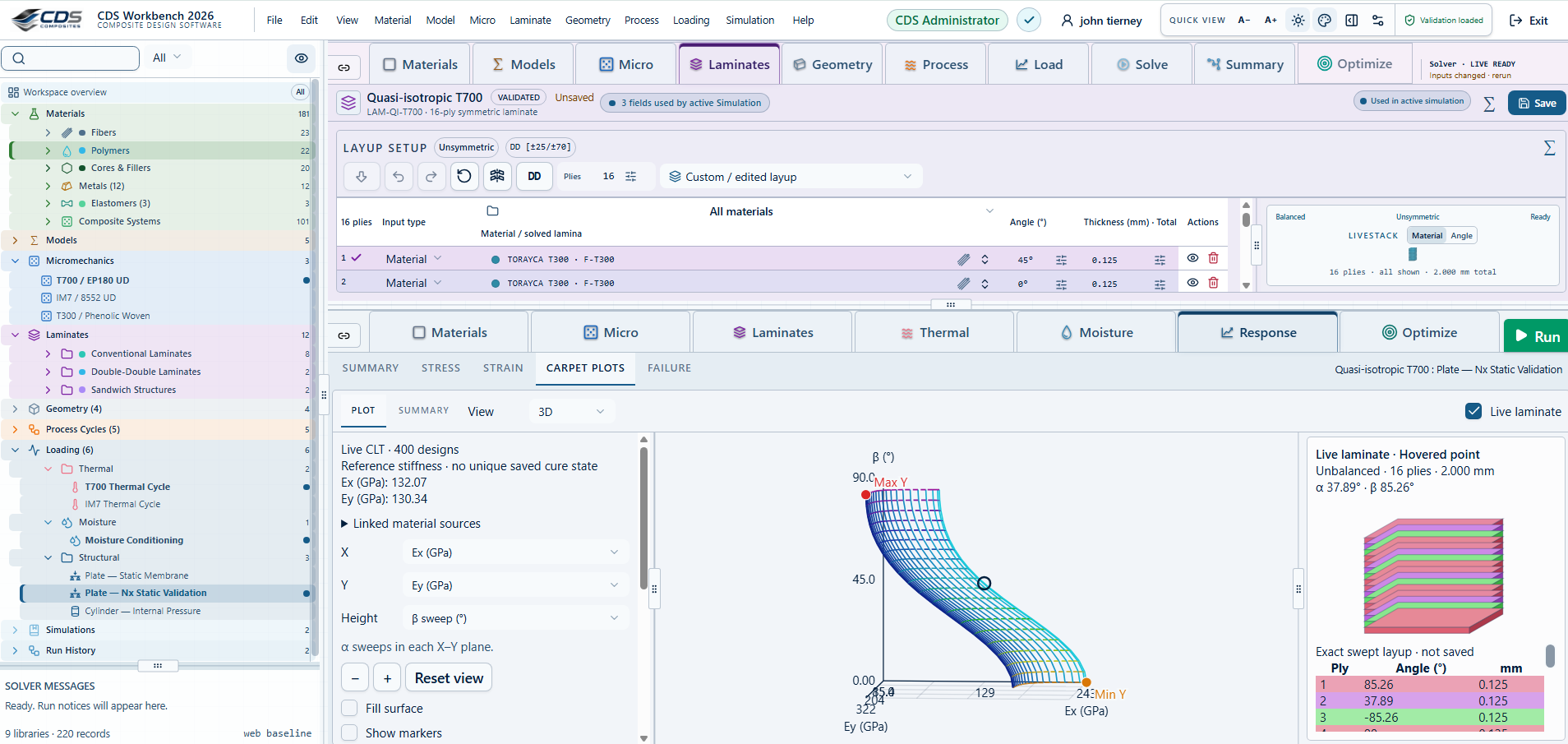
Light-mode Workbench carpet plot and colored laminate stack
06

Live design-space exploration

The light-mode carpet-plot workspace connects a design-space surface to the live laminate. This is an existing GUI capture, not a newly validated result.

Open full-size GUI ↗
CDS Composites

Transparent composite engineering from constituent to structure.

CDS2026 All Rights Reserved