
04.1 / CDS User Guide
Get started with
the CDS Workbench.
A short path from sign-in and a safe first edit to a verified solver run.
Complete manuals · download a whole collection
Each collection includes an editable Word manual and its matching searchable PDF, with linked contents, explanatory text, diagrams and references. Theory equations use native Word mathematics. Individual-page PDF buttons remain available.
These are dated reading editions of the public learning content. Interactive studies and account-controlled classroom notes and databases stay online. For current changes, follow the chapter links back to the website.
Current Workbench, reference editions and downloads
Use the online User Guide for current controls, the released model directory for selectable models and compatibility, and the Training Manual for connected exercises. Wider theory references do not mean every formulation is enabled in Workbench.
Dated GUI captures and compiled Web r18 PDF manuals retain their stated scope; they are not a substitute for current hosted Workbench instructions. Find the overview PDF, guides and exercise databases in Your CDS library.
Stored ply properties bypass Micro. Mixed stacks keep both paths. Gray blocks are not selected. Geometry, process schedules and other model records are omitted here for clarity; a real run must include all required references.
Fatigue uses intact CLT endpoint stresses and measured S–N calibration. It is evaluated separately from Run and progressive failure. The dashed handoff is not active: optimization still uses current properties until a degradation law is supplied.
Materials → Micro → Laminate.
All exercises, case studies and simulation examples → · Your CDS library: overview, manuals and database downloads →
Open the Workbench
Register and verify your CDS account, then sign in and choose SIMULATE to launch Workbench. Account registration is required, including for the 30-day demo. Your active license determines permitted modules and models.
- Confirm the correct account is signed in.
- Choose a starter exercise or open your saved CDS database. Save current work before replacing the workspace.
- Use CREATE for a guided starting design, DISCOVER for exploration, or SIMULATE for the standard workspace.
Understand the workspace
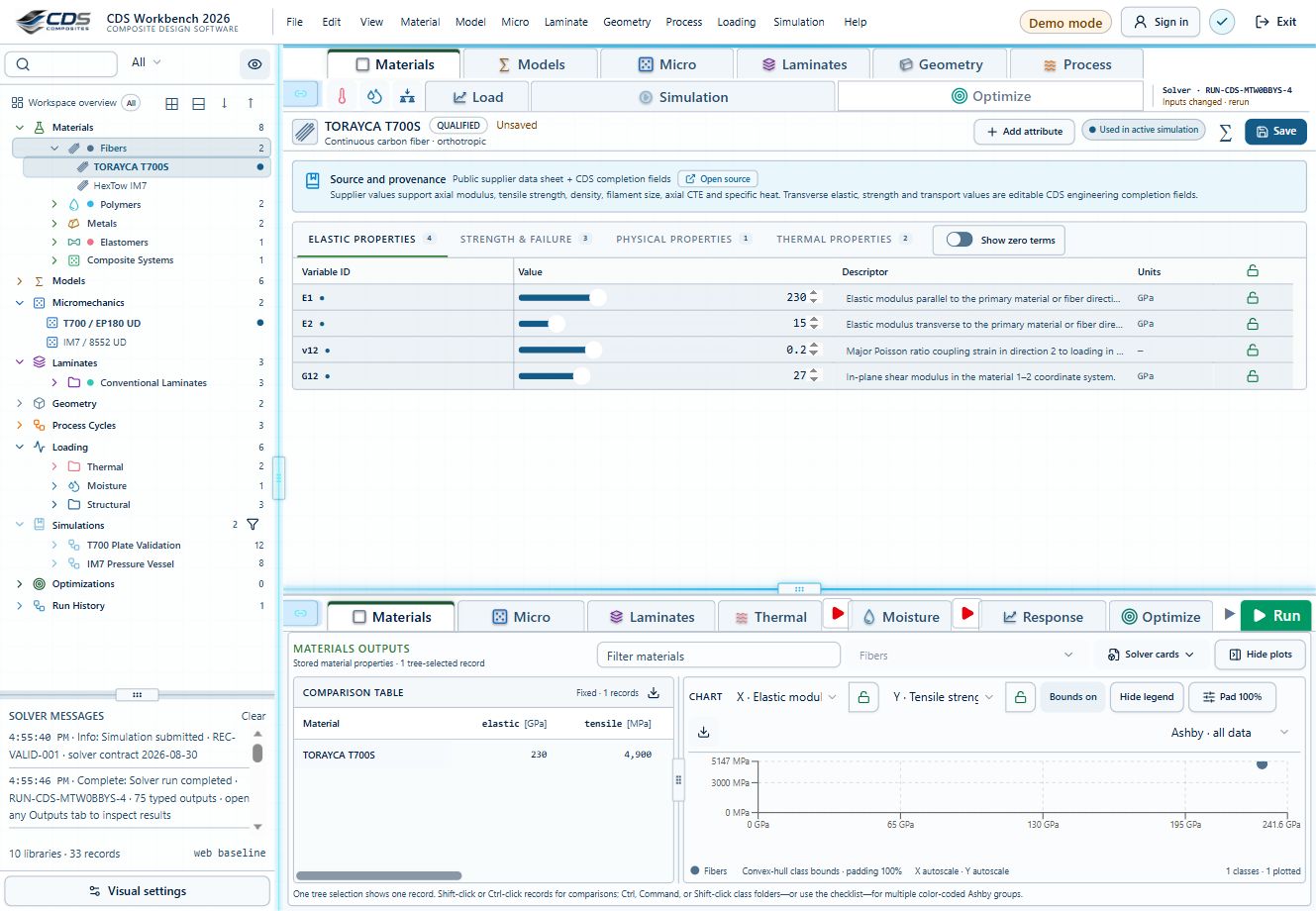
The compact project tree is on the left, the selected record editor occupies the main workspace, and the result summary remains visually separate. Single-click selects a record; use its chevron or double-click the row to open children.
Make your first edit
Duplicate a teaching record, unlock one property, enter a valid numeric value, confirm its units, and lock it again.
- Select the record. See screenshot
- Find the property by its name and description. See screenshot
- Unlock the row, edit the value, then lock it. See screenshot
- Save the record and keep a dependency-complete CDS database checkpoint.
Run and review a case
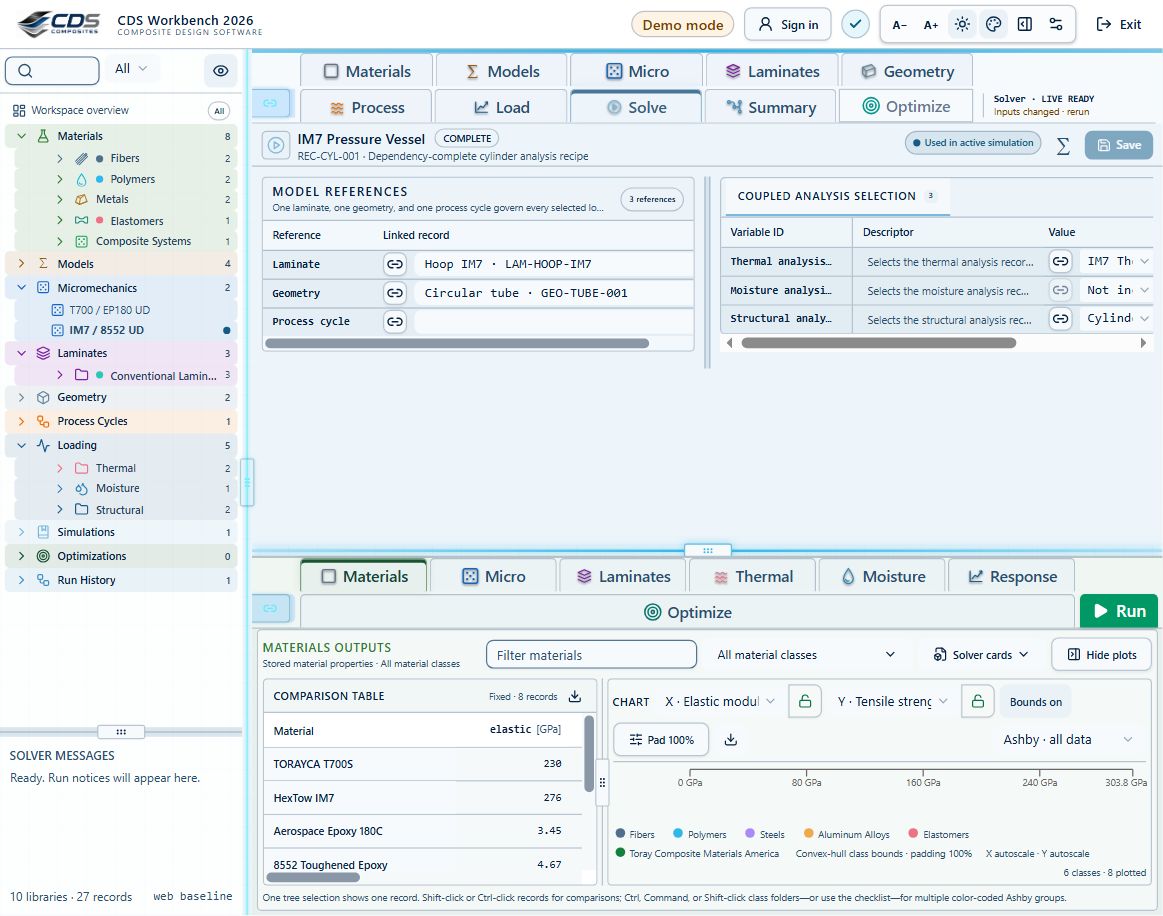
Select a simulation and inspect its connected inputs and model choices in the Simulation workflow. Eligible quick studies refresh after editing pauses; longer calculations require Run.
- Resolve missing setup, invalid inputs and incompatible model selections. See screenshot
- Check geometry, boundary conditions and loading in LiveLoad.
- Choose Run when required and wait for completion. See screenshot
- Review the relevant output and its freshness, units, assumptions and convergence.
Find the manuals and exercise databases
Open Your account → Your CDS library for the current overview PDF, User Guide, Theory Manual and complete exercise collection. Read the exercise instructions and two-layer workflow before opening its database.
Workbench availability: released models, inputs and compatible study paths. The wider theory library includes reference formulations not available in every Workbench solve.