
Independent boundary schedules
Thermal and moisture loads each need compatible material properties, a laminate, initial conditions and their own surface schedule.
Capabilities / 02.5
Solve steady-state or transient through-thickness process response before structural analysis, using effective ply transport properties, independent top and bottom schedules, cure exotherm, cure-dependent modulus, polymer kinetics, water uptake or release, and process-cycle optimization.
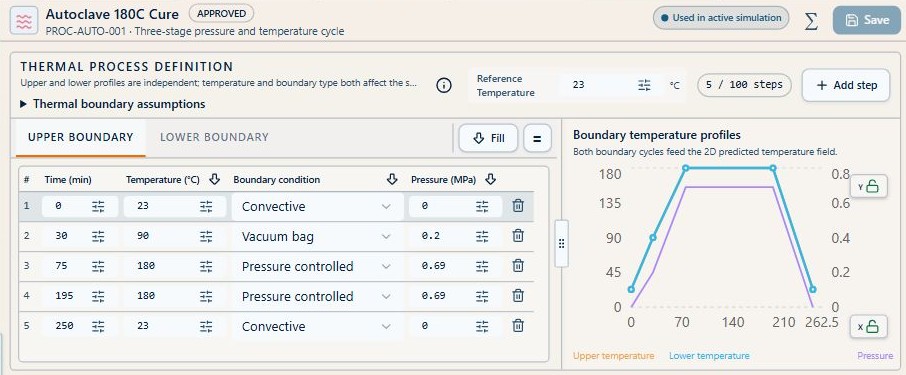
Independent surface schedules define the process boundary conditions; this view shows inputs, not a solved temperature field.
Workbench capture · September 7, 2026. Representative interface and demo data, not a new solver run or validation certificate. Control locations may differ in later releases.Cursor: 30 min · 300 mm · 120.0 °C
02.5 / How CDS solves it
From engineering question to evidenceThermal and moisture loads each need compatible material properties, a laminate, initial conditions and their own surface schedule.
Choose the steady or transient transport model for the study. Transient histories resolve the supported one-dimensional through-thickness problem.
Assigned calibrated material laws govern supported polymer-state calculations. UV cure needs its exposure inputs; pultrusion needs the distance/time relationship and pulling speed.
A process schedule alone is not a solved history. Only compatible coupled analyses consume recovered environmental fields; reference-elastic studies remain separate.
The separate free-release CLT study uses prescribed temperatures and effective shrinkage. It is not a tool-contact simulation or an automatic transfer of the thermal cure history.
Compare bounded cycle candidates under supported objectives, save the evidence and rerun the selected candidate.
Workbench availability: released models, inputs and compatible study paths. The wider theory library includes reference formulations not available in every Workbench solve.
Models → material-model folders · assigned through Materials
Independent model records can be linked together through material inputs. A saved model must be assigned to a material before it contributes to a simulation.
Models browser → Thermal transport · source: CASES / Thermal
One transport formulation per thermal case. Select its laminate and configure its own initial conditions and surface cycle; pultrusion additionally requires a distance-based die schedule and pulling velocity.
Models browser → Moisture transport · source: CASES / Moisture
One formulation per moisture analysis. Thermal and moisture analyses can both be linked in Simulation; each needs its own boundary conditions.
Models → Structural models → ASTM · Virtual Test Lab
Homogeneous slab, initially dry, both faces held at equilibrium moisture. Fits diffusivity from two early uptake measurements (both ≤50% saturation) using the square-root-time approximation. Edge ingress and temperature dependence are excluded. Does not overwrite material properties.
Structural models → Tool-release shape
Free CLT release from prescribed ply-local shrinkage/thermal eigenstrains. Corner spring-in is a separate uniform-strain estimate. Stress-free temperature and effective post-gel shrinkage need calibration. No tool friction, cure kinetics or viscoelastic restraint history.
Outcomes and boundaries
Delivered capability
Methods available in CDSSteady / transient thermal and moisture selections
Initial state and independent surface boundary histories
Assigned cure, crystallization and cure-dependent modulus models
Supported pultrusion and UV cure studies
Bounded process optimization and saved candidate evidence