
Create and classify
Add a blank material, assign the correct material type, and enter the mechanical, thermal, moisture, strength, and source properties required by downstream models.
Capabilities / 02.2
CDS organizes mechanical, thermal, moisture, strength, diffusion, thermoset cure, semicrystalline thermoplastic, processing, and source data into records shared by every downstream model.
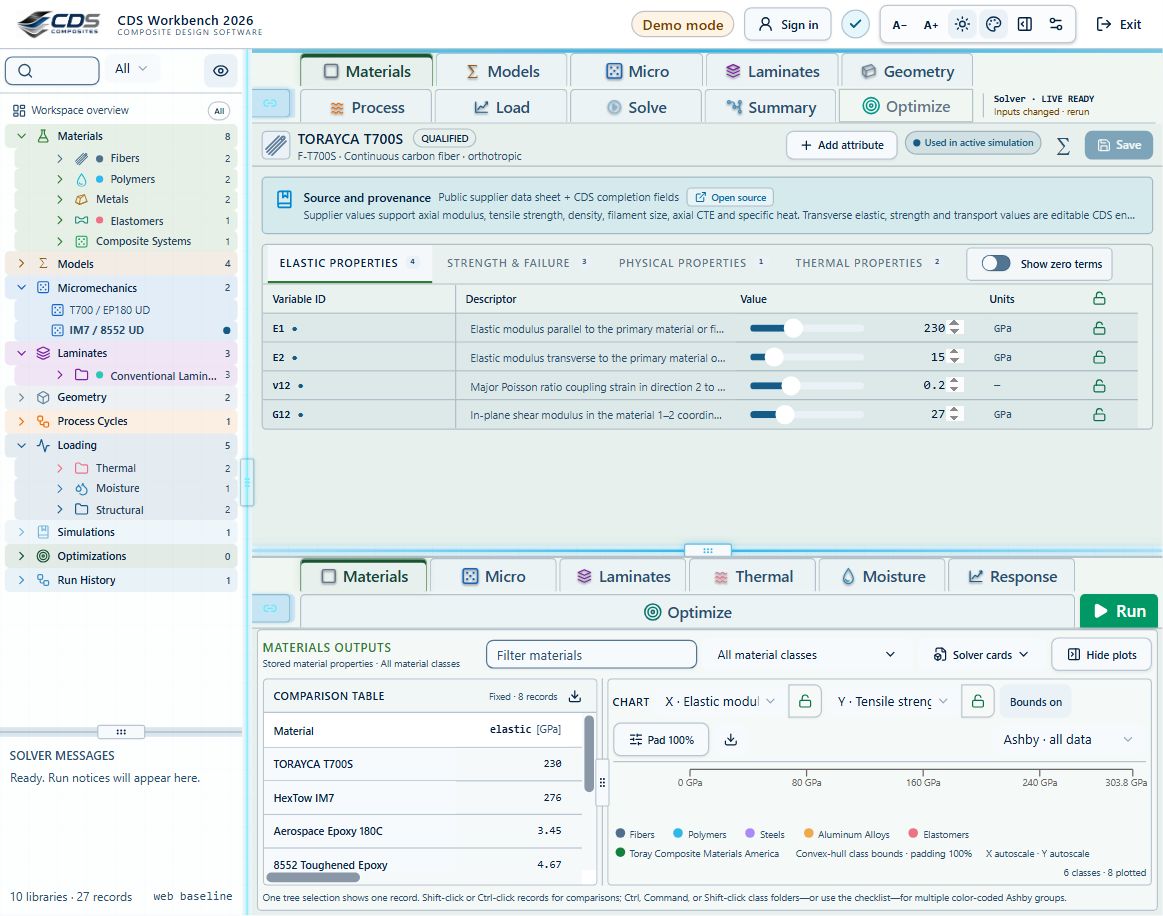
Source-aware material inputs and comparison outputs share one workspace.
Workbench capture · September 7, 2026. Representative interface and demo data, not a new solver run or validation certificate. Control locations may differ in later releases.02.2 / How CDS solves it
From engineering question to evidenceAdd a blank material, assign the correct material type, and enter the mechanical, thermal, moisture, strength, and source properties required by downstream models.
Use the property input controls to enter constants or a simplified temperature–property table with one shared lock. Show zero terms when stored zero-value fields must be completed. The selected units and classification travel with the record.
Store thermoset cure or PEEK/PEKK crystallization kinetics, reaction heat, saturation, diffusivity, and anisotropic process-shrinkage data with the owning matrix or ply.
Duplicate material records for variants, load selected records from another CDS file, and export compatible properties for spreadsheet or finite-element workflows.
Workbench availability: released models, inputs and compatible study paths. The wider theory library includes reference formulations not available in every Workbench solve.
Models → material-model folders · assigned through Materials
Independent model records can be linked together through material inputs. A saved model must be assigned to a material before it contributes to a simulation.
Outcomes and boundaries
Delivered capability
Methods available in CDSProperty tree switches between mechanical, physical, transport, failure, cure/crystallization, cost, and processing data
Composite-vendor classes and Sandwich Structures organize bundled source-aware examples
Thermoset choices include nth-order, Kamal–Sourour, Prout–Tompkins, and diffusion-limited Kamal kinetics
Thermoplastic choices include single- and double-branch Nakamura/Avrami-style crystallization
Standard View edits one selected material; Table View compares and edits multiple records
Zero-term visibility exposes stored zero values for database completion
Up to ten temperature-property pairs can be stored for supported mechanical, physical, and transport properties