
This exercise examines how reinforcement geometry and orientation affect the effective elastic response of a short-fibre material. The aim is to connect the model inputs to the resulting directional properties, while keeping elastic load transfer separate from a prediction of fibre breakage or composite strength.
Open this exercise in Workbench
Prepare the baseline
Before running, note fibre length, diameter, fractions and orientation settings. Change the quantity requested in the task while retaining the other settings, then record all directional moduli rather than only the largest one. Where two geometries have the same aspect ratio, compare their results explicitly; this helps identify which geometric information the selected idealization actually uses.
Worked procedure
1. Open the Micro example and review constituents, volume fractions and architecture.
2. Run and compare E1, E2, E3 and shear moduli with the paired example in this class.
3. Vary fiber length and Fa/Fp independently; explain the stiffness changes.
4. Right-click Micro → Save as composite material. Inspect the independent elastic snapshot and its blank unpredicted properties.
Review checkpoints
Existing exercise records are unchanged; these are additional studies.
Predicted stiffness is not measured strength. Existing example strengths are illustrative teaching inputs only.
Model limits
Teaching-only constituent/architecture assumptions. Elastic screening; no qualification, processing prediction or measured composite strength.
Interpret the comparison
Use the model’s reported transfer and efficiency outputs to explain the stiffness comparison. Treat any displayed fibre geometry as an illustration unless its dimensions are explicitly part of the calculation. If you save the result as a material, inspect which fields were predicted and which remain blank; an elastic snapshot is not a complete set of qualified material properties.
How information passes between models
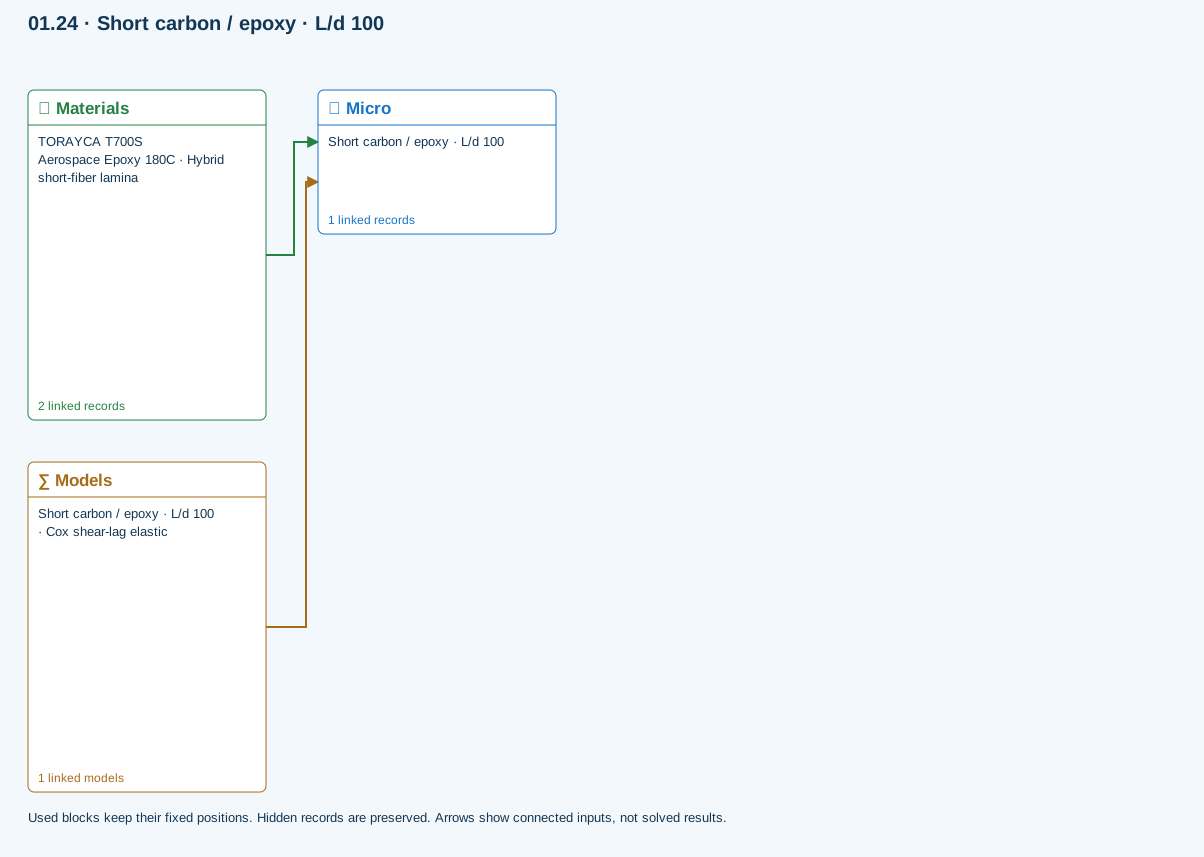
Materials → Micro: Constituent stiffness, strength, density and thermal / moisture properties.
Models → Micro: Applied model assignment: Cox shear-lag elastic. Model parameters and formulation are used by Micro.
Further reading and evidence
- Create and connect a lamina
- Edit material properties and units
- Run and review a model
- Review effective properties
- Connected inputs and result freshness
- Related case study: NASA lamina analysis
Review the recorded validation scope. Retain the original inputs and solver notices with the results. Representative teaching data are not design allowables.
References and source sections
References are retained with the formulations they support. Software instructions describe implementation scope; a cited source does not establish independent validation of a CDS calculation.