
The starting point for a laminate calculation is the behaviour of its individual plies. Here you will follow the connection from fibre and resin properties to the effective properties of a unidirectional ply, using controlled comparisons to see which predictions depend on composition and which depend on the micromechanics formulation.
The copied T700/EP180 database is a connected starter, not T700/PR520. Complete the constituent setup below before comparing with NASA.
Open this exercise in Workbench
Prepare the baseline
Establish the supplied case before changing anything. Keep a small comparison table with the constituent properties, fibre fraction, selected model and resulting moduli. When the task changes the model, leave the material data unchanged; when it changes the fraction, keep the model fixed. This makes it possible to explain the source of a difference instead of merely observing that two numbers disagree.
Worked procedure
1. Open the linked web walkthrough and NASA/TM–2015-218814. Rename the copied constituents for this study; enter T700 E1/E2/G12 = 230/15/27 GPa, ν12 = 0.20 and density 1.80 g/cm³. Enter PR520 E/ν/G = 4.0 GPa/0.38/1.44 GPa and density 1.25 g/cm³. Preserve the research citation; do not substitute the starter resin properties.
2. Use continuous unidirectional micromechanics with zero voids. Evaluate Vf = 0.375, 0.733 and 0.800, holding every other input fixed. Save three copies or an optimization comparison.
3. Compare E1/E2/G12 against 88.5/6.22/2.60, 169.5/9.90/7.00 and 184.7/10.9/6.00 GPa respectively. Report 100 × (CDS − reference) / reference; compare another supported homogenization model.
4. Save the chosen predicted lamina and source links. Leave unsupported strength and transport data unavailable; do not carry over unrelated starter allowables.
Review checkpoints
Published MAC/GMC values are external comparison data, not exact acceptance targets for Halpin–Tsai.
Keep the three local fiber-volume regions separate; averaging braid subcells needs justification.
Model limits
Constituent-to-lamina screening only. The NASA braid subcells, calibrated LS-DYNA damage and coupon validation are not reproduced.
Interpret the comparison
Read longitudinal, transverse and shear results as different responses, rather than expecting one mixture estimate to describe them all. Where the exercise provides published comparison values, calculate the discrepancy using those values and the specified units. Agreement in stiffness does not establish measured strength or validate properties that the chosen model does not predict.
How information passes between models
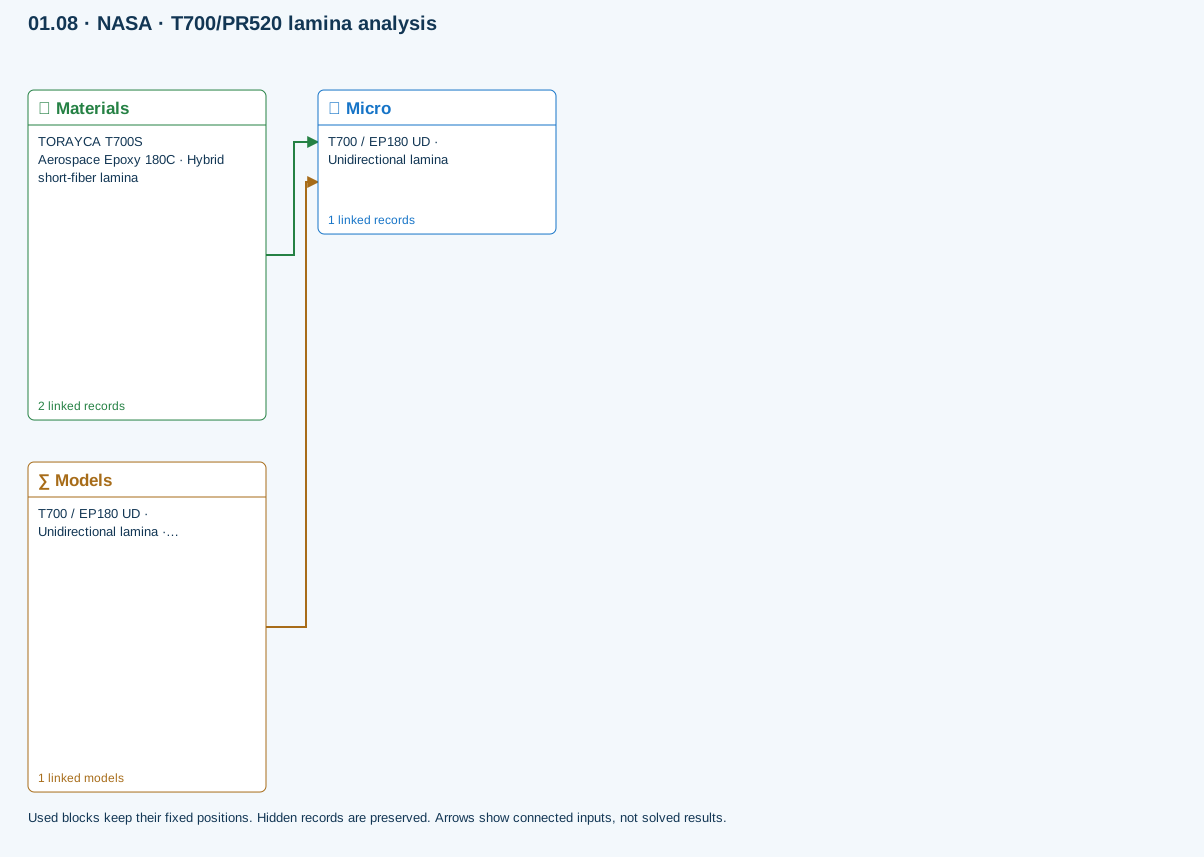
Materials → Micro: Constituent stiffness, strength, density and thermal / moisture properties.
Models → Micro: Applied model assignment: Halpin–Tsai. Model parameters and formulation are used by Micro.
Further reading and evidence
- Related case study: NASA lamina analysis
- Edit material properties and units
- Create and connect a lamina
- Review effective properties
- Connected inputs and result freshness
- Run and review a model
Review the recorded validation scope. Retain the original inputs and solver notices with the results. Representative teaching data are not design allowables.
References and source sections
References are retained with the formulations they support. Software instructions describe implementation scope; a cited source does not establish independent validation of a CDS calculation.