
VIRTUAL TESTING / CDS WORKBENCH
ASTM D7137 · Compression after impact
Measures a damaged composite plate's remaining compression strength after impact or indentation.
CDS sign-in and suitable licensed access may be required.
Recorded instructional case · Workbench captures and saved calculation data, October 2026. This website preview does not run the test.
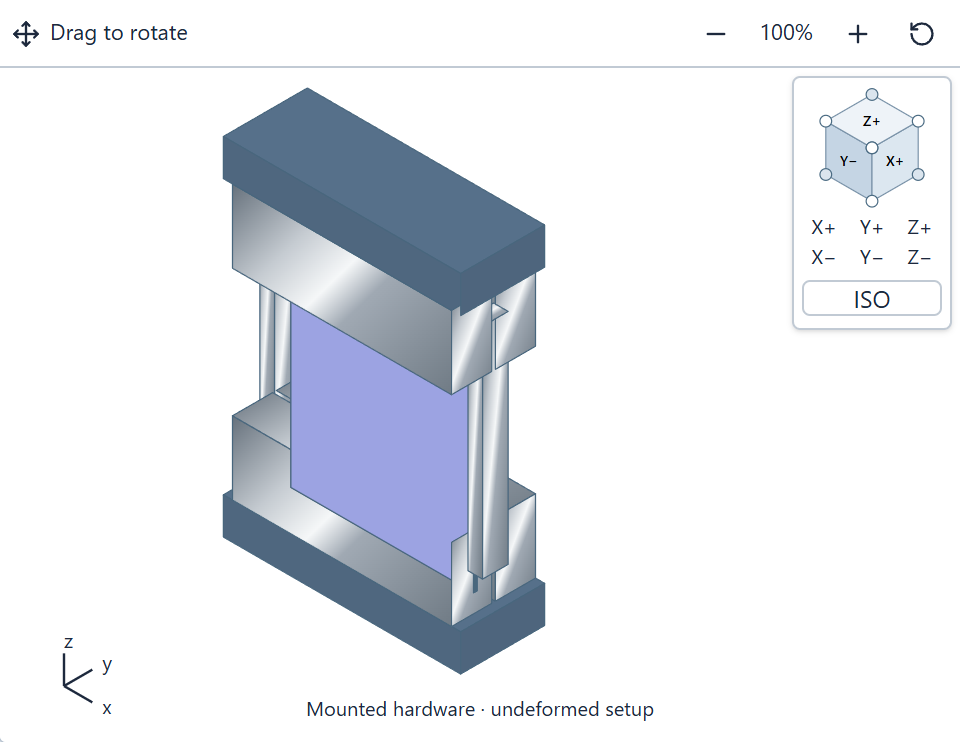
Specimen & fixture
Calculated assessment
Compressive strength (MPa)
Strength reference
View plotted values
| Series | Strength reference | Compressive strength (MPa) |
|---|---|---|
| Native measured-input assessment | Supplied pristine | 400 |
| Native measured-input assessment | CAI from supplied peak | 150 |
The CAI peak force and pristine reference are supplied measurements, not predictions from impact energy.
Set up in CDS
- Link the impacted laminate thickness and coupon width.
- Enter the measured peak compression-after-impact force.
- Enter matched pristine compressive strength.
- Calculate CAI strength and retained-strength fraction.
Inputs for this recorded case
- 150 × 100 × 2 mm
- 16 plies / 2 mm
- Selected force 30000 N
- Explicit source calibration/properties
These are teaching-case inputs, not ASTM-prescribed specimen dimensions or acceptance criteria.
Readout & interpretation
- Measured CAI strength
- 150 MPa
- CAI / pristine strength
- 0.375 —
Measured CAI assessment. Residual strength does not follow from the impact-energy calculation.
About this ASTM reference
Standard Test Method for Compressive Residual Strength Properties of Damaged Polymer Matrix Composite Plates
Active catalog edition checked October 10, 2026. The official standard defines the physical method; the CDS example below has a narrower modeling scope. Full procedures remain on ASTM’s site.
Find this setup in Workbench
Opens the connected guided study. Select the matching ASTM setup in the Test menu to inspect its fixture.
What this CDS case represents
Read the actual ASTM standard ↗Measured CAI assessment. Residual strength does not follow from the impact-energy calculation.
This analytical or measured-data model provides its own curves and metrics. Synchronized failure playback is not supported; a mounted fixture view does not imply that contact, crack growth or impact history is solved.
Model basis · equation and interpretation
Eincident = mv²/2; Erebound = mvr²/2; XCAI = Ppeak/(wt).
m is striker mass, v measured incident speed, vr measured rebound speed, Ppeak measured CAI peak force, w coupon width and t thickness. Energy not returned includes losses other than damage. Retention is XCAI divided by matched pristine compressive strength, not an energy-to-strength prediction. No impact pulse or damage footprint is generated.
Instructional model comparison, not experimental validation or ASTM certification. Physical testing requires the licensed standard and a qualified test program.
Impact, indentation and residual strength
D7136 uses a drop-weight impact. D6264 uses quasi-static center indentation. D7137 assesses compression of a damaged plate from independent measured test data.
D7766/D7766M-23 ↗ supplies sandwich-specific modifications to the impact and indentation methods. The present thin-plate model does not resolve core crushing or qualify that physical test.
The referenced methods have polymer-composite material scopes. New metal and ceramic database classes do not imply qualification under those methods.