
An environmental structural study is useful only if the temperature or moisture state used by the mechanical calculation is known. This exercise traces that handoff and compares the connected result with a deliberately controlled reference, so that changes in strain or ply stress can be attributed to the enabled contributions.
Open this exercise in Workbench
Prepare the baseline
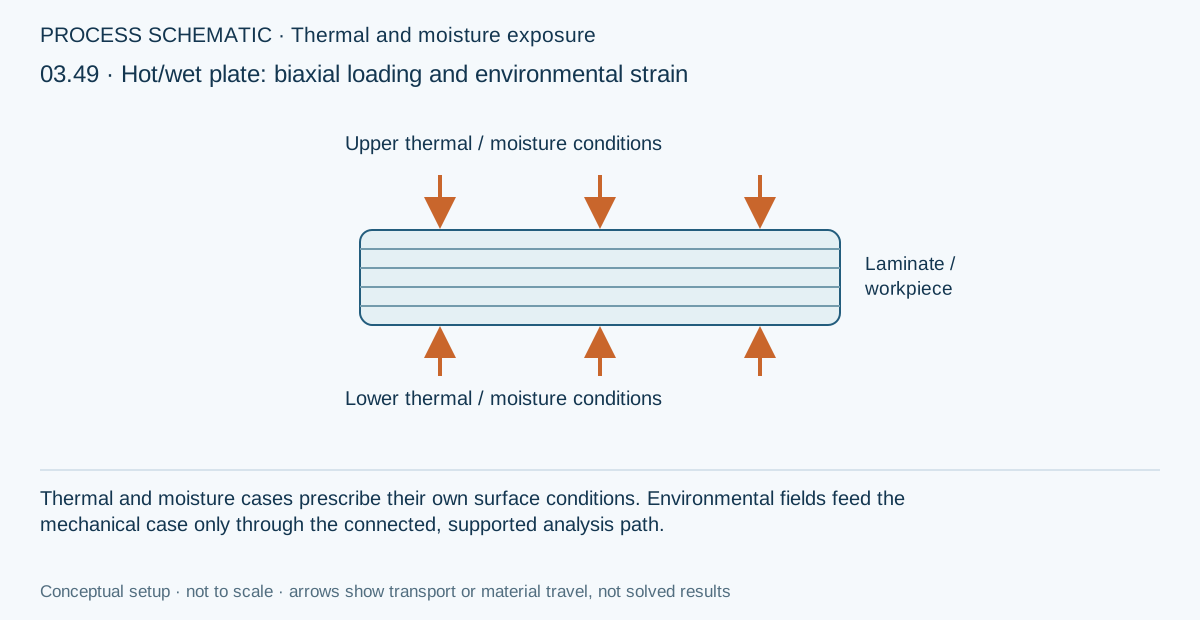
Follow each selected case to the shared laminate, noting its own schedule and reference state. Record which cases are actually connected; some examples include moisture without thermal loading or use different resin systems in the same stack. Follow the specified disconnection procedure for the reference run and check that no separate mechanical process link remains active unintentionally.
Worked procedure
1. Trace Thermal, Moisture and Mechanical to the same laminate; record the reference temperature and reference moisture.
2. Run the connected plate. Record the transferred environmental state, membrane strains, ply stresses and available failure indices.
3. Make a mechanical-only comparison by disconnecting both environmental cases and clearing the Mechanical process-case link. Run at unchanged loads.
4. Reconnect one environmental case at a time and rerun. Compare thermal-only, moisture-only and combined contributions; preserve a result table.
Review checkpoints
Nx, Ny and Nxy are resultants per unit width, not total forces.
Separate free environmental expansion from applied mechanical strain.
State-dependent stiffness can make the combined result differ from a simple sum; do not assume chemical degradation or measured hot/wet strength reduction.
Model limits
Teaching inputs, not qualified allowables. Sequential coupling transfers the reported thermal/moisture state to laminate mechanics; it is not simultaneous 3D multiphysics. Inspect the transferred state and reference values before interpreting stress or curvature.
Interpret the comparison
Compare the transferred state as well as the mechanical outputs. Keep load, geometry and layup unchanged unless the task explicitly varies them, and explain whether the difference comes from free strain, state-dependent stiffness or another supported effect. Environmental exposure does not automatically imply strength degradation in every solver branch.
How information passes between models
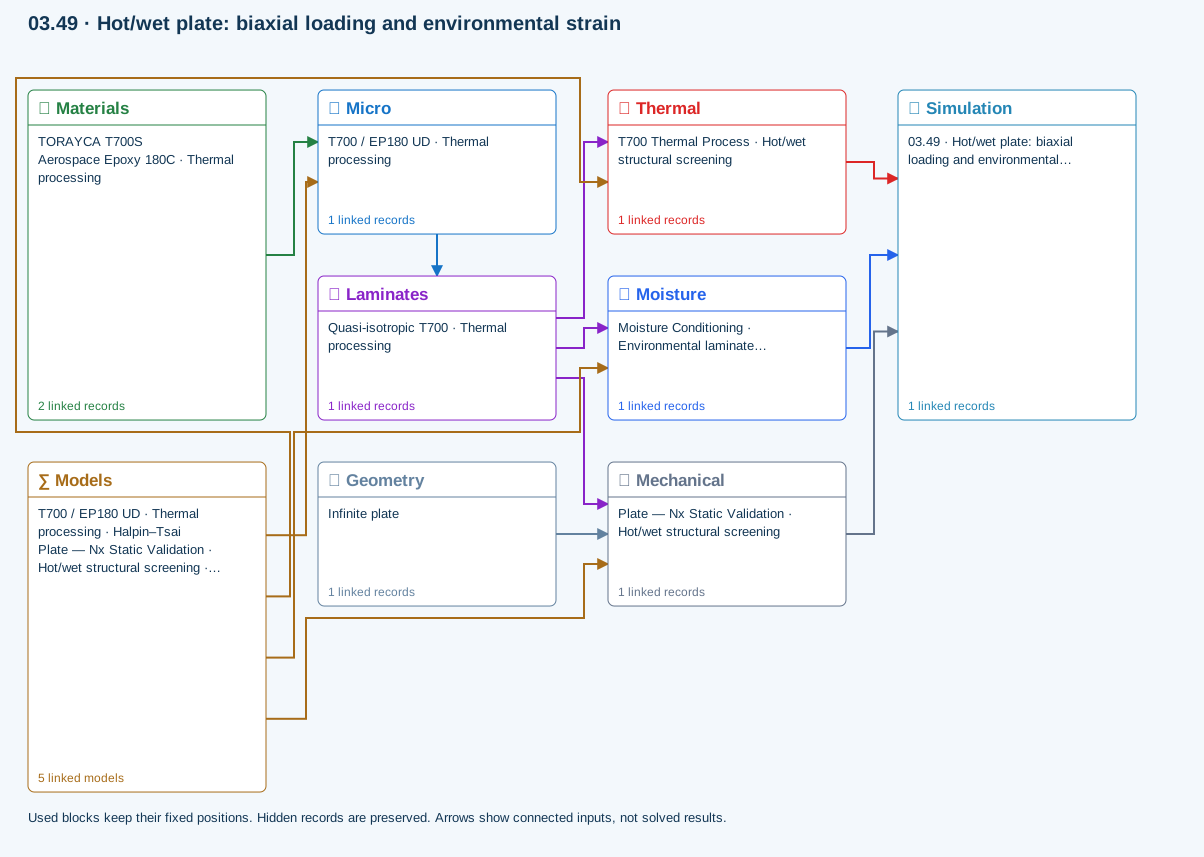
Micro → Laminates: Predicted ply stiffness, strength, density and expansion properties.
Materials → Micro: Constituent stiffness, strength, density and thermal / moisture properties.
Mechanical → Simulation: SIMULATION selects this case and its analysis model; the case owns its applicable cycle and input references.
Laminates → Mechanical: Ply angles and thicknesses, stiffness, mass and ply properties.
Geometry → Mechanical: Part shape and dimensions, thickness or section definition, and model-specific geometric inputs. Each selected case consumes only the dimensions its model supports.
Moisture → Simulation: SIMULATION selects this case and its analysis model; the case owns its applicable cycle and input references.
Laminates → Moisture: Ply angles and thicknesses, stiffness, mass and ply properties.
Thermal → Simulation: SIMULATION selects this case and its analysis model; the case owns its applicable cycle and input references.
Laminates → Thermal: Ply angles and thicknesses, stiffness, mass and ply properties.
Models → Micro: Applied model assignment: Halpin–Tsai. Model parameters and formulation are used by Micro.
Models → Mechanical: Applied model assignment: CLT · Linear static with failure indices. Model parameters and formulation are used by Mechanical.; Maximum stress
Models → Moisture: Applied model assignment: 1D transient moisture diffusion. Model parameters and formulation are used by Moisture.
Models → Thermal: Applied model assignment: 1D transient heat transfer. Model parameters and formulation are used by Thermal.
Further reading and evidence
- Connect a simulation
- Edit laminate materials, angles and thicknesses
- Run and review a model
- Cure exotherm and evolving modulus
- Enter a process cycle and boundary conditions
- Connected inputs and result freshness
- Review effective properties
- Apply symmetry and balance
- Related case study: NASA process cure
Review the recorded validation scope. Retain the original inputs and solver notices with the results. Representative teaching data are not design allowables.
References and source sections
References are retained with the formulations they support. Software instructions describe implementation scope; a cited source does not establish independent validation of a CDS calculation.