
VIRTUAL TESTING / CDS WORKBENCH
ASTM D7249 · Sandwich facesheet flexure
Uses long-span sandwich-beam bending to characterize facesheet strength and stiffness.
CDS sign-in and suitable licensed access may be required.
Recorded instructional case · Workbench captures and saved calculation data, October 2026. This website preview does not run the test.
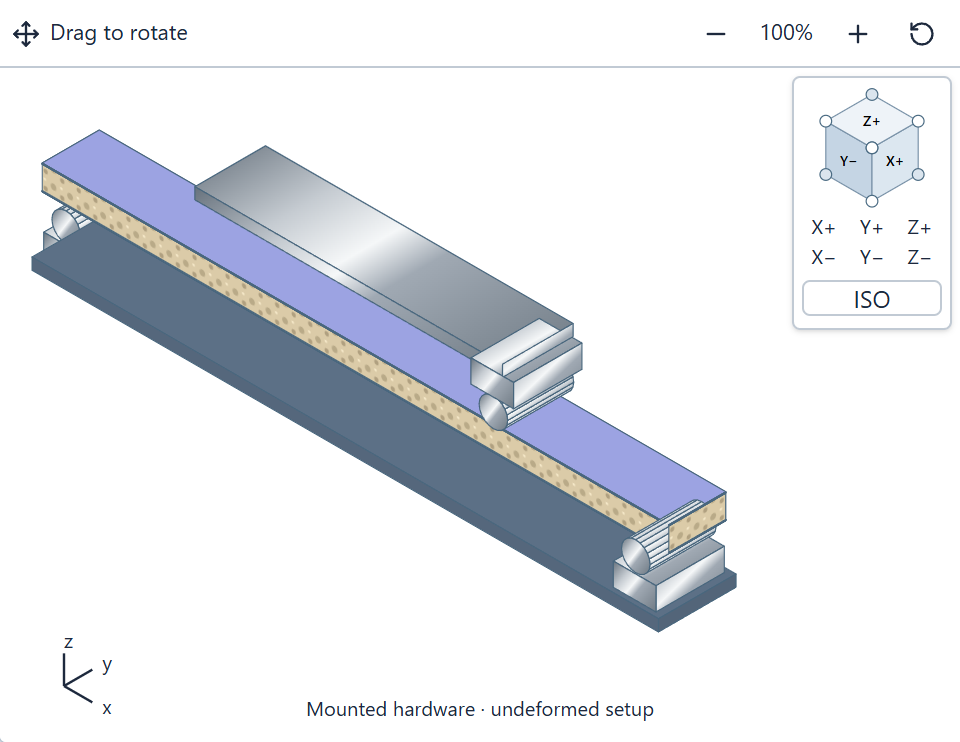
Specimen & fixture
Calculated assessment
Total machine force (N)
Midspan deflection (mm)
View plotted values
| Series | Midspan deflection (mm) | Total machine force (N) |
|---|---|---|
| Ideal sandwich midspan response | 0 | 0 |
| Ideal sandwich midspan response | 1.8676788754273108 | 499.99999999999994 |
Set up in CDS
- Link equal facesheets and the core dimensions.
- Define the long support span and inner loading span.
- Enter face Ex, core G and total machine force.
- Review midspan deflection, core shear and face stress.
Inputs for this recorded case
- 550 × 50 × 22 mm
- 17 plies / 22 mm
- Selected force 500 N
- Explicit source calibration/properties
These are teaching-case inputs, not ASTM-prescribed specimen dimensions or acceptance criteria.
Response & readout
Mean face stress magnitude (MPa)
Total machine force (N)
View plotted values
| Series | Total machine force (N) | Mean face stress magnitude (MPa) |
|---|---|---|
| Nominal facesheet screening | 0 | 0 |
| Nominal facesheet screening | 500 | 29.76190476190476 |
- Maximum bending moment
- 31,250 N·mm
- Nominal core shear stress
- 0.2381 MPa
- Mean facesheet stress magnitude
- 29.76 MPa
All recorded readouts
- Maximum bending moment
- 31,250 N·mm
- Nominal core shear stress
- 0.2381 MPa
- Mean facesheet stress magnitude
- 29.76 MPa
- Core shear demand / measured strength
- 0.2381 —
- Facesheet tension demand / measured strength
- 0.05952 —
- Facesheet compression demand / measured strength
- 0.09921 —
- Linked total sandwich thickness
- 22 mm
- Facesheet flexural rigidity
- 7.723e+8 N·mm²
- Core shear rigidity
- 44,100 N
- Midspan bending deflection
- 1.159 mm
- Midspan shear deflection
- 0.7086 mm
- Midspan total deflection
- 1.868 mm
Ideal elastic sandwich beam. Contact indentation, wrinkling and damage growth are excluded.
About this ASTM reference
Standard Test Method for Facesheet Properties of Sandwich Constructions by Long Beam Flexure
Active catalog edition checked October 10, 2026. The official standard defines the physical method; the CDS example below has a narrower modeling scope. Full procedures remain on ASTM’s site.
Find this setup in Workbench
Opens the connected guided study. Select the matching ASTM setup in the Test menu to inspect its fixture.
What this CDS case represents
Read the actual ASTM standard ↗Ideal elastic sandwich beam. Contact indentation, wrinkling and damage growth are excluded.
This analytical or measured-data model provides its own curves and metrics. Synchronized failure playback is not supported; a mounted fixture view does not imply that contact, crack growth or impact history is solved.
Instructional model comparison, not experimental validation or ASTM certification. Physical testing requires the licensed standard and a qualified test program.